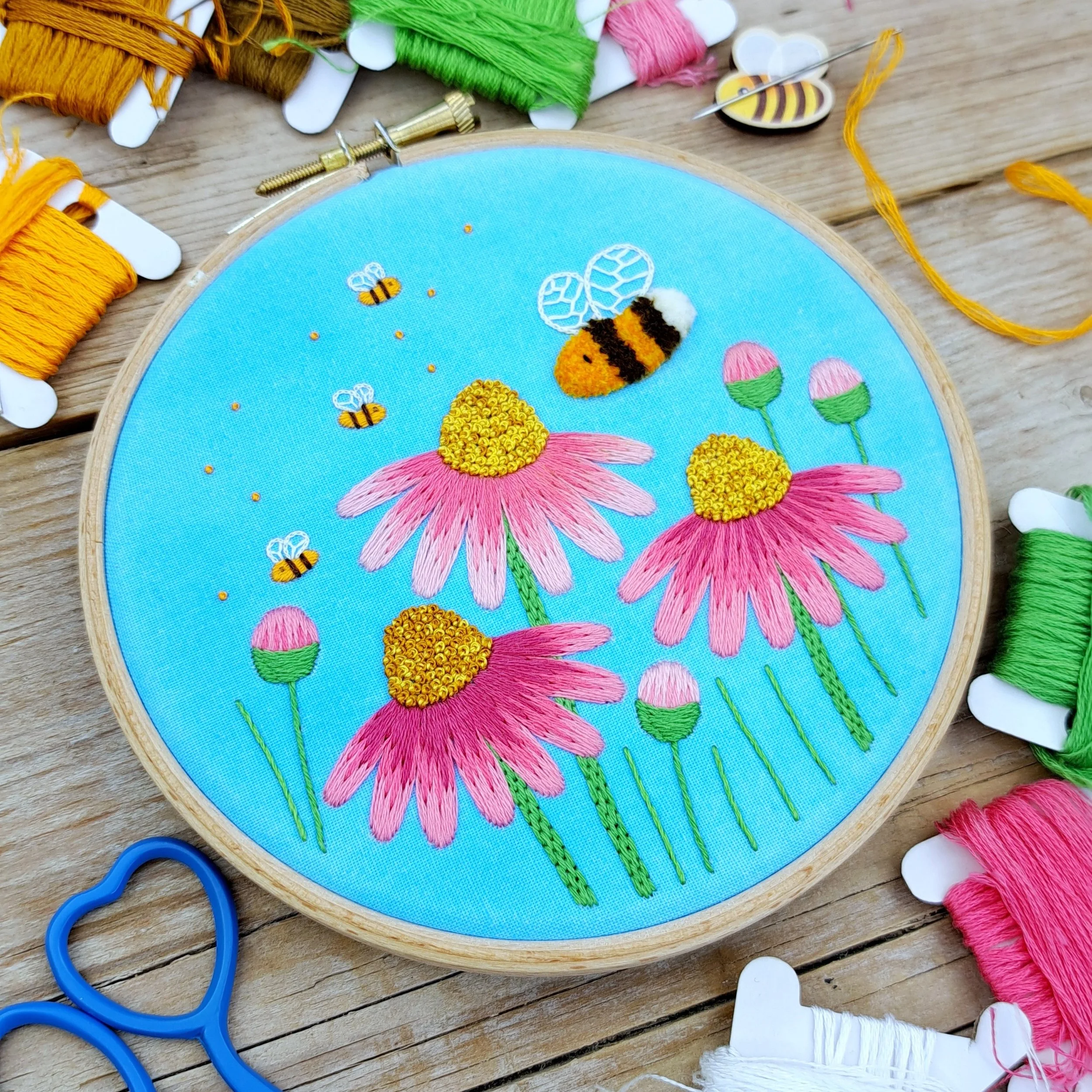
How I Stitched the Bee and Echinacea Panel: A Step-by-Step Guide
About a month ago now, I launched my brand new Bees & Blooms collection - it’s such a pretty one, and after working on it for months (I started illustrating back in November and finally launched in April), I was over the moon with how it all came together. As part of that collection, I designed this embroidery panel: the Bees and Echinaceas panel.
Echinaceas are one of my absolute favourite flowers (even though I never seem to have much luck growing them in the garden 😅), and I just loved the idea of a panel filled with those big, beautiful blooms, little buds, and a few busy bees buzzing around.
As soon as I finished drawing it, I couldn’t wait to get it into a hoop and start stitching.
If you’ve just stumbled across me and my embroidery panels – hello and welcome! I’m Liz – the illustrator, maker and stitcher behind Bluebell Love. I’ve been stitching for many, many years now, and like most stitchers, I’ve built up quite the stash of embroidery threads. Some I bought because I just had to have the colour (magpie instincts), others are leftovers from kits, some were gifts, and a few I’m convinced just magically appeared 😏. And if you’re anything like me, I’m guessing you’ve got a good stash growing too!
That’s exactly why I created these embroidery panel designs – they’re pre-printed, so you can pop them straight into a hoop and get stitching, using all those lovely threads that deserve to be seen (not hidden away in a box!).
And just like with all of my embroidery panels… there are no rules 😄. Use your favourite colours, your favourite stitches, and stitch as much or as little as you like. Just the outlines, a few pops of colour, or go full-on and cover the whole panel.
For this embroidery I used 13 thread colours from my stash (pretty pared-back for me 😄). You absolutely don’t need all of them - it’ll look lovely with fewer colours too. I had a lot of fun stitching with a couple of shades at once in a couple of places and used 4 pinks just for the petals.
Now that the bees are all stitched up, I’ll walk you through exactly how I did it in this step-by-step guide. I’ll cover the stitches, threads, needle sizes, techniques, and a few little tips along the way. I also played around with adding watercolour paint to the fabric before I started stitching – it’s a fun way to add more colour without stitching the whole hoop. I’ll show you how I did that too, but if it’s not your thing, feel free to skip ahead to the stitching part.
Let’s get stitching! 🪡
What You’ll Need
Time to gather your supplies! Here’s everything you’ll need to get started on your Bee & Echinacea embroidery panel:
A Bee and Echinacea embroidery panel
A 5” embroidery hoop
Some extra white fabric to double up inside your hoop
Embroidery needles (I’ll chat through sizes in a bit)
A selection of embroidery threads
A pair of sharp scissors
Watercolour paints
Paintbrushes
A cup of water (for the paints)
A plastic sheet to protect your surface (I used a bin liner – anything waterproof will do!)
And of course… a nice hot cuppa ☕ (and even some biccies!) 🤭
Don’t worry – I’ll talk through each of these in more detail below so you know exactly what I used and why.
A Bee and Echinacea Embroidery Panel
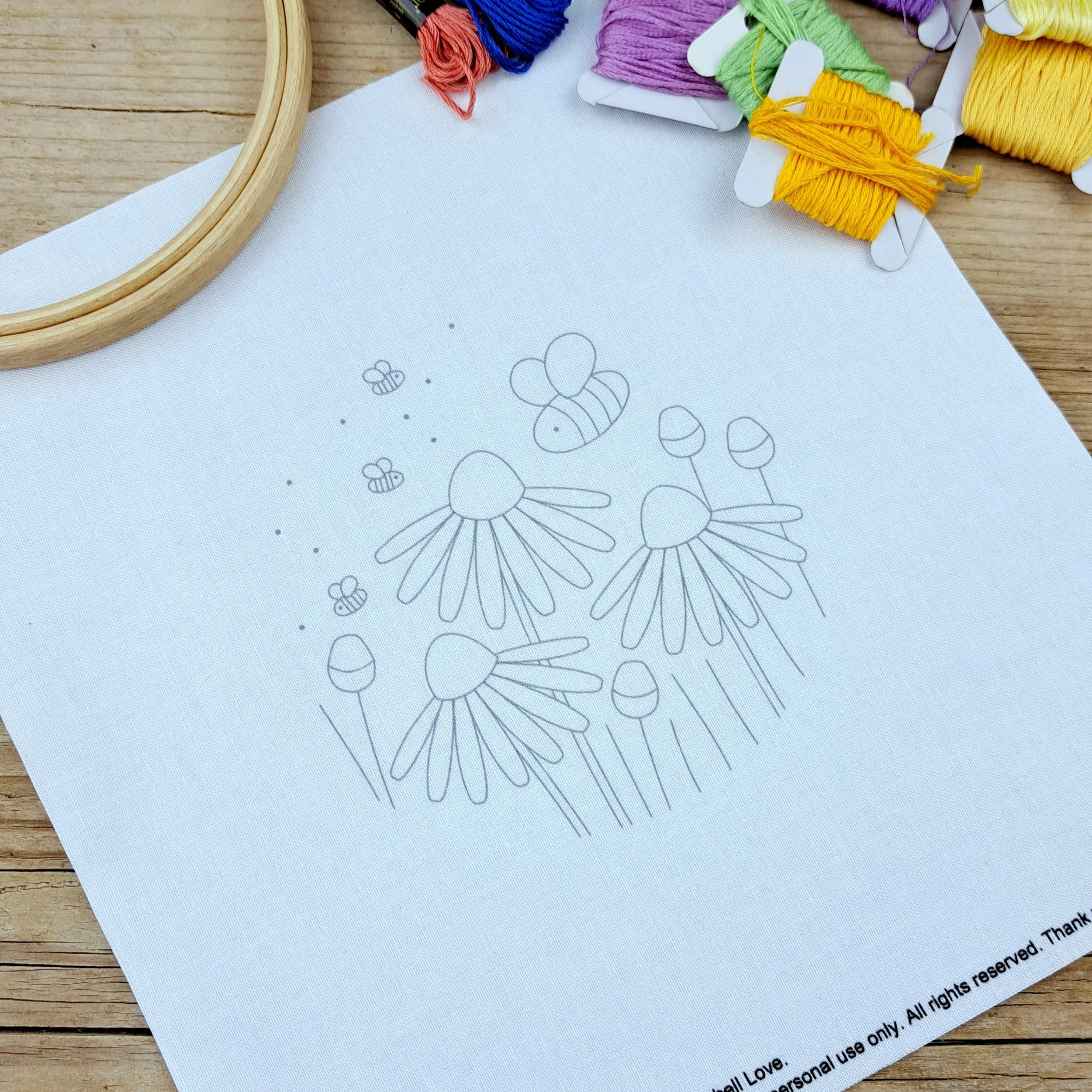
First up, you’ll need one of my Bee and Echinacea embroidery panels. This design was digitally illustrated by me and printed onto 100% cotton fabric using eco-friendly, water-based pigment inks – all made right here in the UK 🌿
You can grab your panel from my shop here:
I also offer this design as part of a Panel Pack, which includes a 5” hoop and extra backing fabric – perfect if you’re just getting started or want everything bundled together 😊
A 5” Embroidery Hoop
This design fits snugly in a 5” hoop. I always recommend using a hardwood hoop – they’re more durable and hold a more consistent tension while stitching. Being a natural material, wooden hoops sometimes have little imperfections, but in my experience, hardwood ones tend to grip the fabric better and have fewer gaps.
Extra White Fabric
I highly recommend doubling up your fabric in the hoop!
I didn’t do this when I stitched the Rabbit Panel – and honestly, I really wish I had 😬 For this bee panel, I added an extra layer of plain white cotton behind the printed panel, and it made such a difference. Especially if you’re leaving your background fabric white, this helps it stay crisper and prevents thread tails from showing through.
Even though I added watercolour to this one, I still doubled up – it helped keep the tension nice and firm, and I didn’t want to risk the same mistakes again.
So if you can, definitely go with two layers!
Embroidery Needles
The right needle can make a huge difference in how easy it is to stitch and how tidy your stitches turn out.
Embroidery needles come in different sizes, and here’s what to keep in mind:
Larger needles: Best for stitching with all 6 strands of embroidery thread. They create bigger holes in the fabric, so if you’re using fewer strands, your stitches might shift of leave gaps.
Smaller needles: Great for finer stitching with 1-2 strands. If you use them with too many strands, it can be tricky to pull the thread through smoothly.
To keep things simple, I offer needle packs in my shop with six needles in three sizes:
Large needles: For stitching with 6 strands.
Medium needles: For stitching with 3–4 strands.
Small needles: For stitching with 1–2 strands.
I’ll refer to these sizes throughout the guide to help you follow along easily.
🧵 You can grab a needle pack from my shop here:
Embroidery Threads
For this project, I mainly used Anchor 6-stranded cotton threads, but with a couple of DMC shades mixed in too. They’re both brilliant quality brands, with vibrant colours that hold up beautifully over time.
I picked my colours from my (very full!) thread stash – but feel free to choose colours that you love. A rough colour plan can be handy before you start, but don’t be afraid to change your mind as you go. I change my mind all the time once I start stitching!
Here’s the full list of the 13 colours I used:
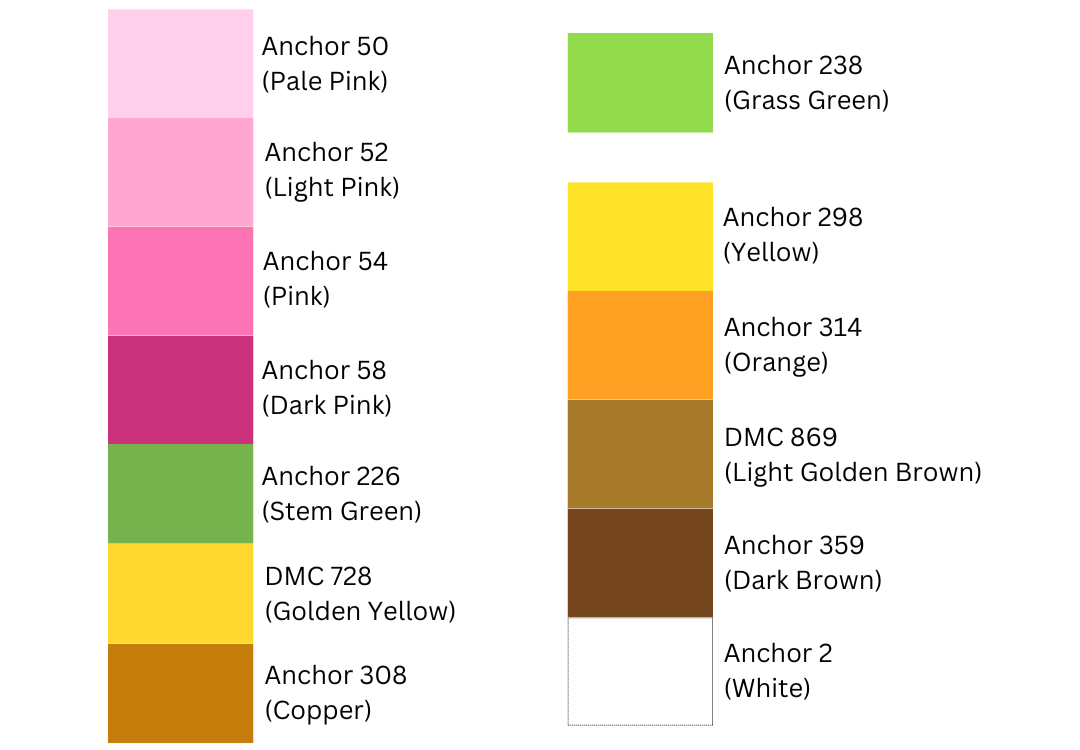
Anchor 50 – Pale pink, Anchor 52 – Light Pink, Anchor 54 – Pink, Anchor 58 – Dark Pink, Anchor 226 – Stem Green, DMC 728 – Golden Yellow, Anchor 308 – Copper, Anchor 238 – Grass Green, Anchor 298 – Yellow, Anchor 314 – Orange, DMC 869 – Light Golden Brown, Anchor 359 – Dark Brown, Anchor 2 – White.
Anchor and DMC threads are numbered for easy reference, so if you’d like to match the colours I used exactly, just look for these numbers. But honestly – this is your project! Choose the colours that make you happy.
Scissors
Any sharp scissors will do the trick, but embroidery scissors are ideal. Their small, pointed blades make it much easier to trim threads neatly and get into tight spaces.
If you don’t have embroidery scissors, no stress – any small, sharp pair from your sewing kit will work just fine.
Watercolour Paints
For this panel, I used a palette of watercolour paint blocks I picked up at my local craft shop. It has a lovely mix of colours – perfect for creating soft, blended backgrounds.
You can use whatever watercolours you like: blocks, tubes, or even pencils. Just have fun with your colour choices and mix them to create the effect you want.
I definitely recommend testing your paints on some scrap fabric first though. It really helps you get a feel for how the colour behaves on fabric.
Paintbrushes
I used two brushes for this project:
– A larger round brush to wet the fabric
– A mid-sized brush for adding the paint
You don’t need anything fancy – just use what you’ve got! A round brush is great for soft washes, and anything with a finer tip will help with smaller details.
Cup of Water
Just a little container for rinsing your brush between colours – I use an old mug. Just try not to accidentally drink from it instead of your tea… but hey, it happens to the best of us 😏
A Plastic Sheet
Painting on fabric can be a bit messy - the water and paint will soak through.
I’d definitely recommend protecting your table with a waterproof sheet of some sort.
I just cut up a bin liner and taped it down to my desk – nothing fancy, but it works perfectly!
A Nice Hot Cuppa
I’m a tea girl… but you do you! 😊☕
2. Painting the Background
Watercolours are super simple to use and so much fun to play with. That said, they aren’t permanent - so they will wash out. This can be both a blessing and a bit of a curse!
On one hand, if something doesn’t go to plan, you can wash it out or layer over it with more paint and water to change it. But on the other hand, it’s not ideal if you’re planning to wash your embroidery once it’s finished - so mine is staying happily in its hoop on the wall.
For this panel, I went with a simple soft blue wash for the background - I was going for a bright, spring/summer feel. But you can completely change the look and feel of your panel depending on the colours you choose.
For some of my other designs, I’ve used different techniques to create effects like pretty sunrises or coastlines (check out those blogs for how I painted those) - so if you fancy getting extra creative here, please do! 😃
✨ A Few Watercolouring Tips
Protect your table with a plastic sheet (I used a bin liner).
Wipe down the plastic sheet - paint and water can pool underneath the fabric and affect your paint
Keep holding your embroidery hoop over your fabric to check you’ve painted all the areas you want to include.
Avoid oversaturating your paints. Too much pigment can stiffen the fabric, which makes stitching trickier. Keep your paints watered down for a smoother application.
Watercolours always dry lighter than they look when wet, so I highly recommend testing your colours on a scrap piece of fabric first. It’s a great way to experiment with blends and get a feel for how they’ll behave on fabric.
The Process
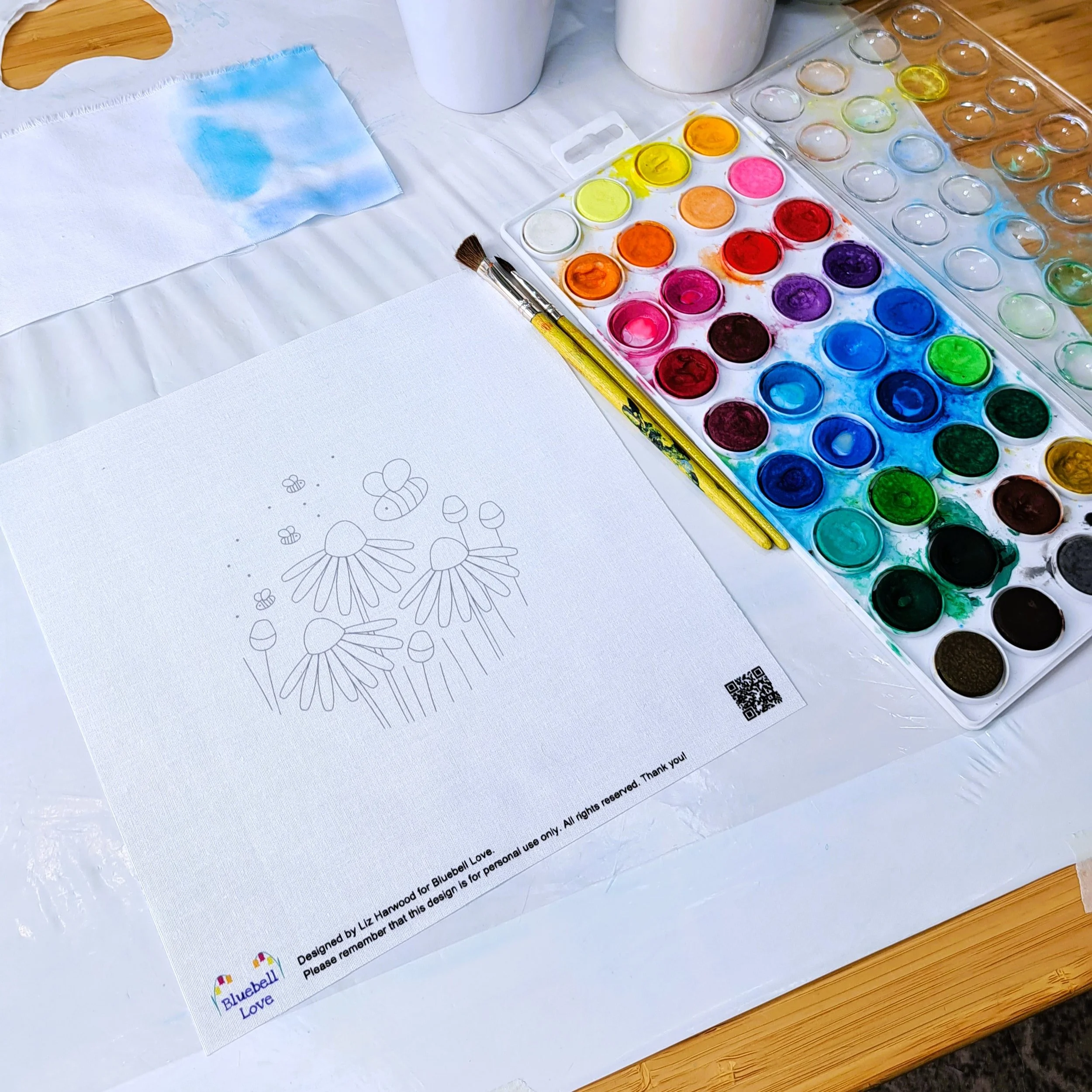
First things first: protect your table.
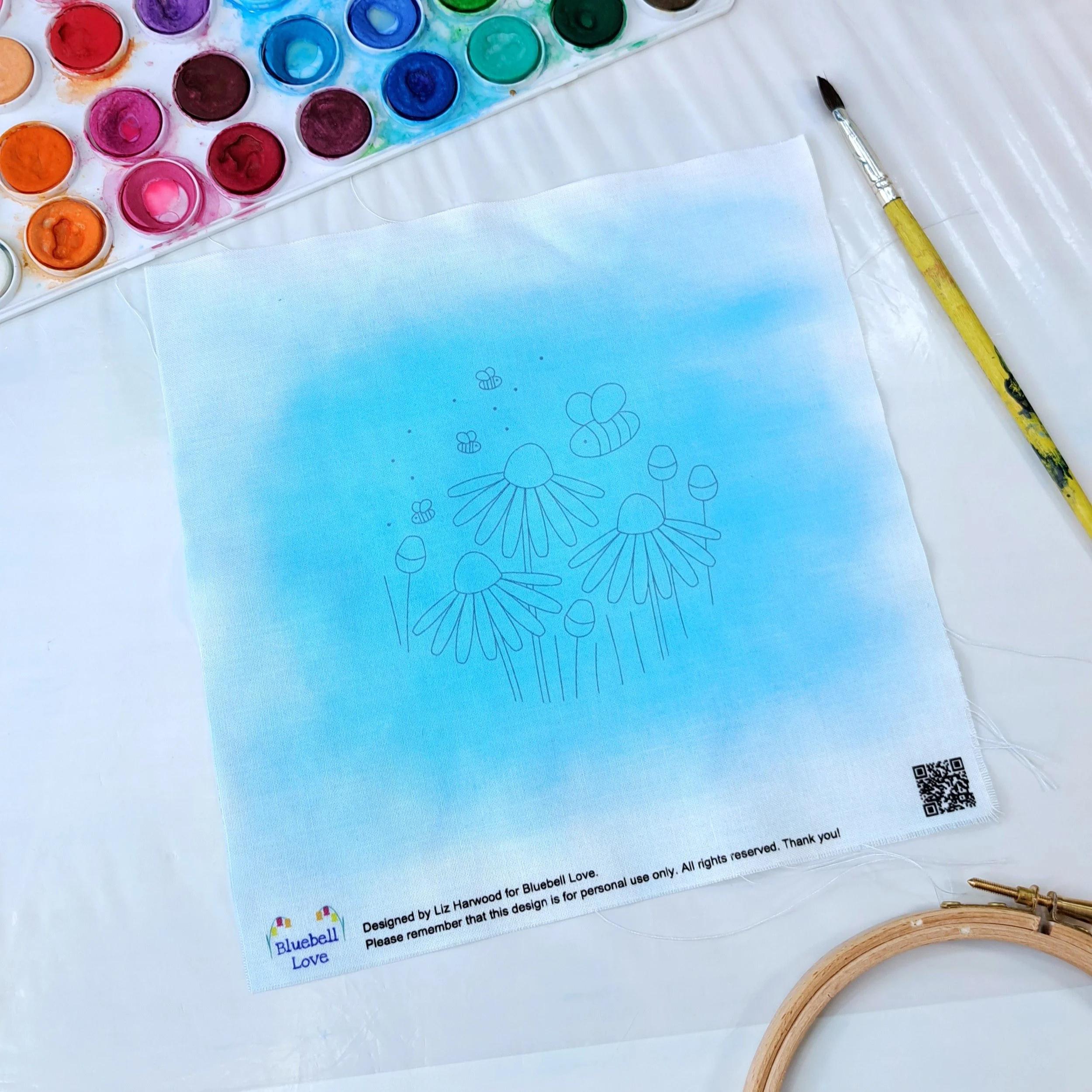
I used a bin liner cut open and taped it tightly to my desk with masking tape. Pulling it taut helps avoid any wrinkles that could trap water or paint. Then I laid the embroidery panel on top, ready to go.
Have a Rough Plan
For this one, I kept things simple - just a full sunny blue background. I’d already planned to completely stitch the flowers, bees, and all the details, so I wasn’t worried about painting over any of the design lines.
The Techniques
There are a few different ways to use watercolours on fabric. The two I use most often are:
Wet on Wet - paint onto wet fabric for a soft, blended look.
Wet on Dry - paint onto dry fabric for more control over where the paint goes.
For this Bee panel, I used the wet on wet technique for one smooth, even wash across the entire panel.
The Painting
First, I used my large round brush to wet the entire panel with clean water – just brushing it on like you would paint until the entire panel is wet through.
Then I picked up some blue paint with my smaller brush and gently started brushing it on the fabric. As soon as the paint touches the wet surface, it begins to spread and bleed out - which is exactly what you want with this technique.
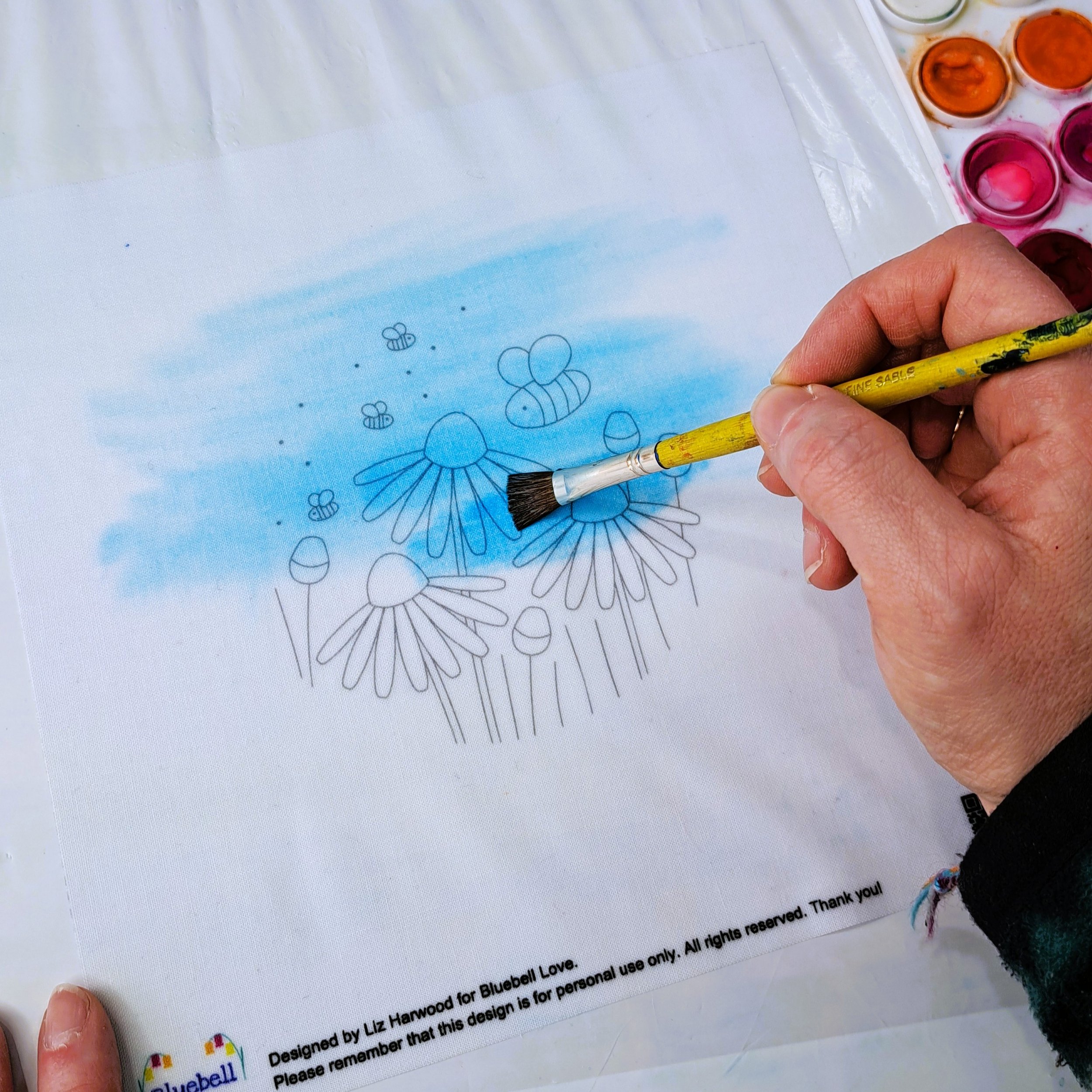
Each brush stroke softens and blends into the next, creating that lovely even wash.
And that’s really all there is to it! I kept going until the whole area (slightly beyond where my hoop would sit) was covered.
Don’t forget you can really have fun and play with different effects to make your panel your own. I just used one colour this time, but you could play with bands of colours - horizontal bands, circular blends, off-centre colour bursts, a few soft clouds, or even a leafy background. There are so many ways you can make it your own using this simple technique.
✨ A Little Tip:
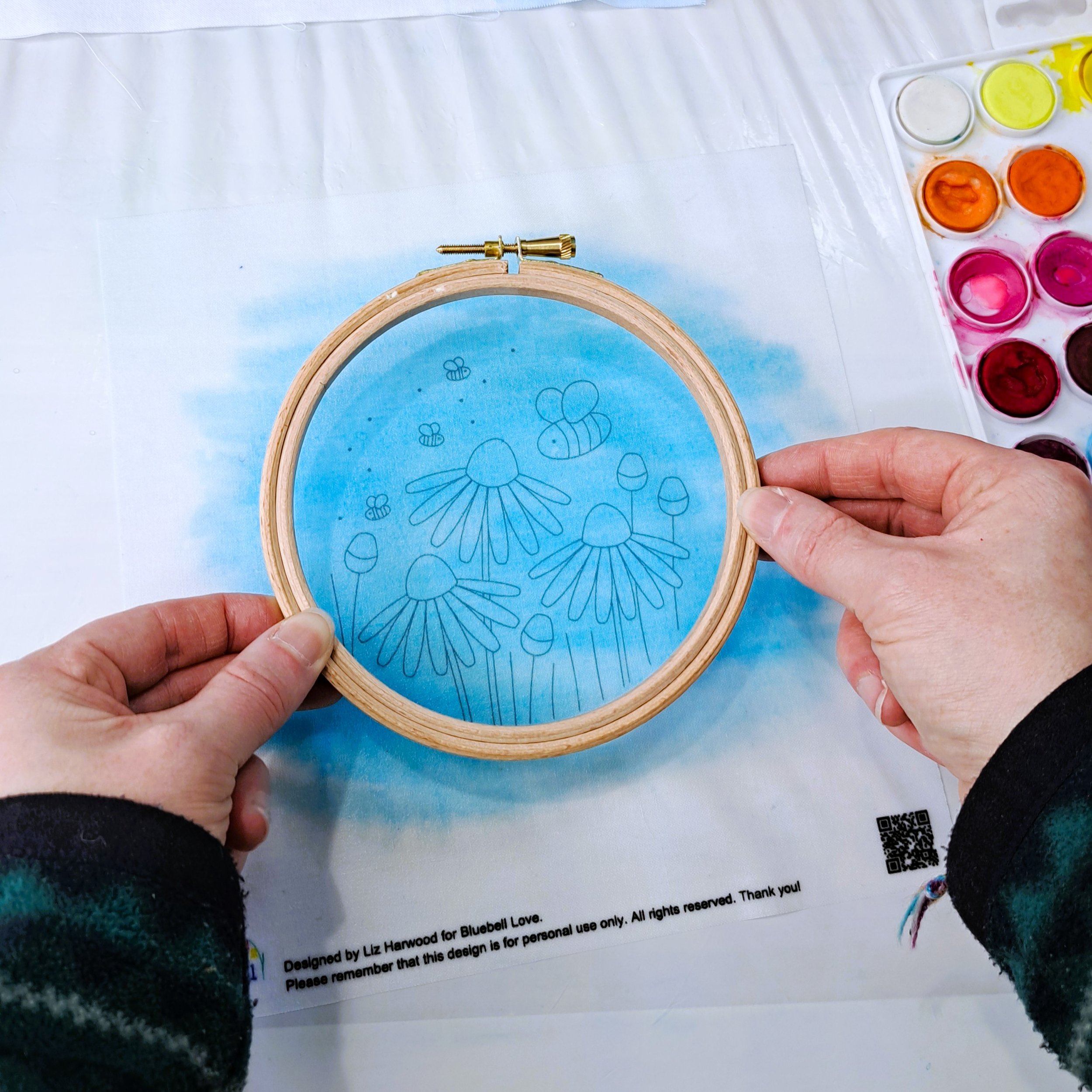
Keep holding your hoop over the fabric as you go - it’s the easiest way to make sure you haven’t missed any edges. I’ve lost count of how many times I thought I was finished, only to spot a tiny white corner at the end!
Drying the fabric
Once I was happy with the painting, I let it dry completely. I’m not very patient, so I used a hairdryer 😅 Just make sure you keep the panel flat while it dries - if you hang it up while it’s still damp, the paint might run.
And don’t forget to wipe any paint puddles from your plastic sheet underneath before moving your fabric - it’s amazing how sneaky those can be!
Give it a little Iron
Once everything was dry, I gave the panel a quick press with the iron (no steam!). I find it softens the paint slightly and makes stitching that little bit easier. Just remember - water will wash the paint out, so definitely no steam here!
3. The Stitches
For this Bee and Echinacea panel I used:
Brick Stitch
Satin Stitch
French Knots
Whipped Backstitch
Straight Stitch
Stem Stitch
Feather Stitch
Split Stitch
Turkey Stitch
Fly Stitch
Couch Stitch (just a few little ones)
I didn’t realise I’d used so many until I came to write this up! That said - you absolutely don’t need to use all (or any!) of these. I love mixing stitches to bring texture, but if there’s one you don’t enjoy… life’s too short to be stitching things we don’t love 💙
So feel free to swap in stitches you do love. Or, if you’re feeling adventurous, add a few extras! Most importantly - have fun with it. 😊
If you’d like a little extra help, check out my Stitch of the Week page - it’s my growing library of tutorial videos. Not every stitch may be up yet, but I add new ones regularly.
4. Let’s Start Stitching
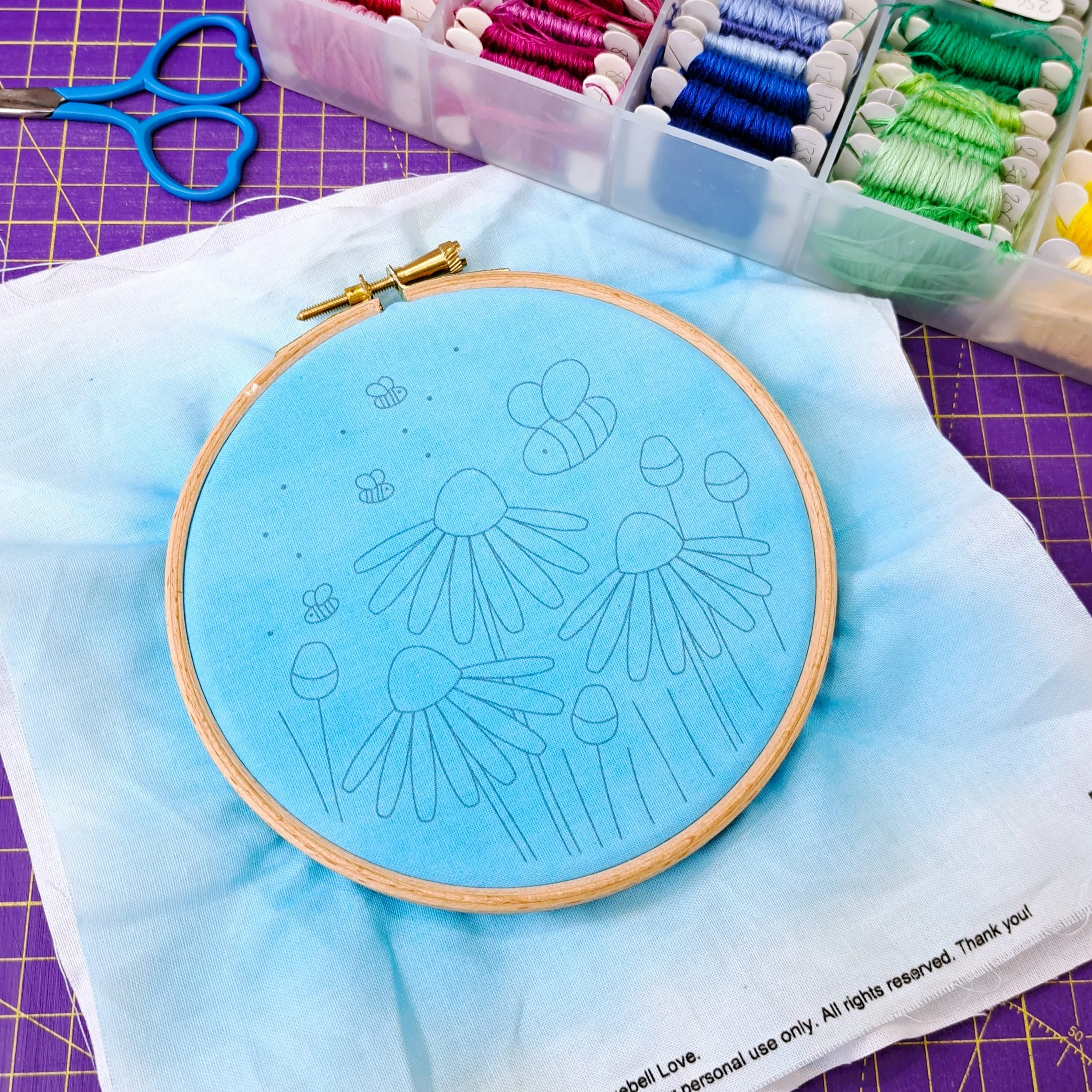
First things first - pop your panel (with that extra backing fabric) into your hoop and get everything nice and taut. I always aim for a satisfying drum-like tension - it helps keep stitches neat and stops the fabric puckering.
How to Get That Drum Tension:
Lay the fabric over the inner hoop, then press the outer hoop down on top.
Gently pull the edges of the fabric outside the hoop to smooth out any wrinkles or bumps.
Tighten the screw mechanism until the hoop feels secure.
Give the fabric around the edges one final little tug to tighten it up even more.
Your fabric should now feel tight like a drum - perfect and ready for stitching!
✨ A little Tip:
Tension can loosen as you stitch. If that happens, pause and tighten the hoop again before carrying on.
5. Step-by-Step Stitching Guide
You can start stitching wherever you like - if a particular part makes you excited, just dive in! I usually recommend working from the back forward so foreground elements sit neatly on top, but it’s not a hard rule. This design has lots of overlapping bits, so starting at the back can help the finished piece look tidy, though you can always tuck stitches behind other areas if needed.
There are quite a few elements in this design, but don’t worry - I’ll walk you through how I stitched each one, step by step.
Okay, onto the stitching!
The Grass Blades
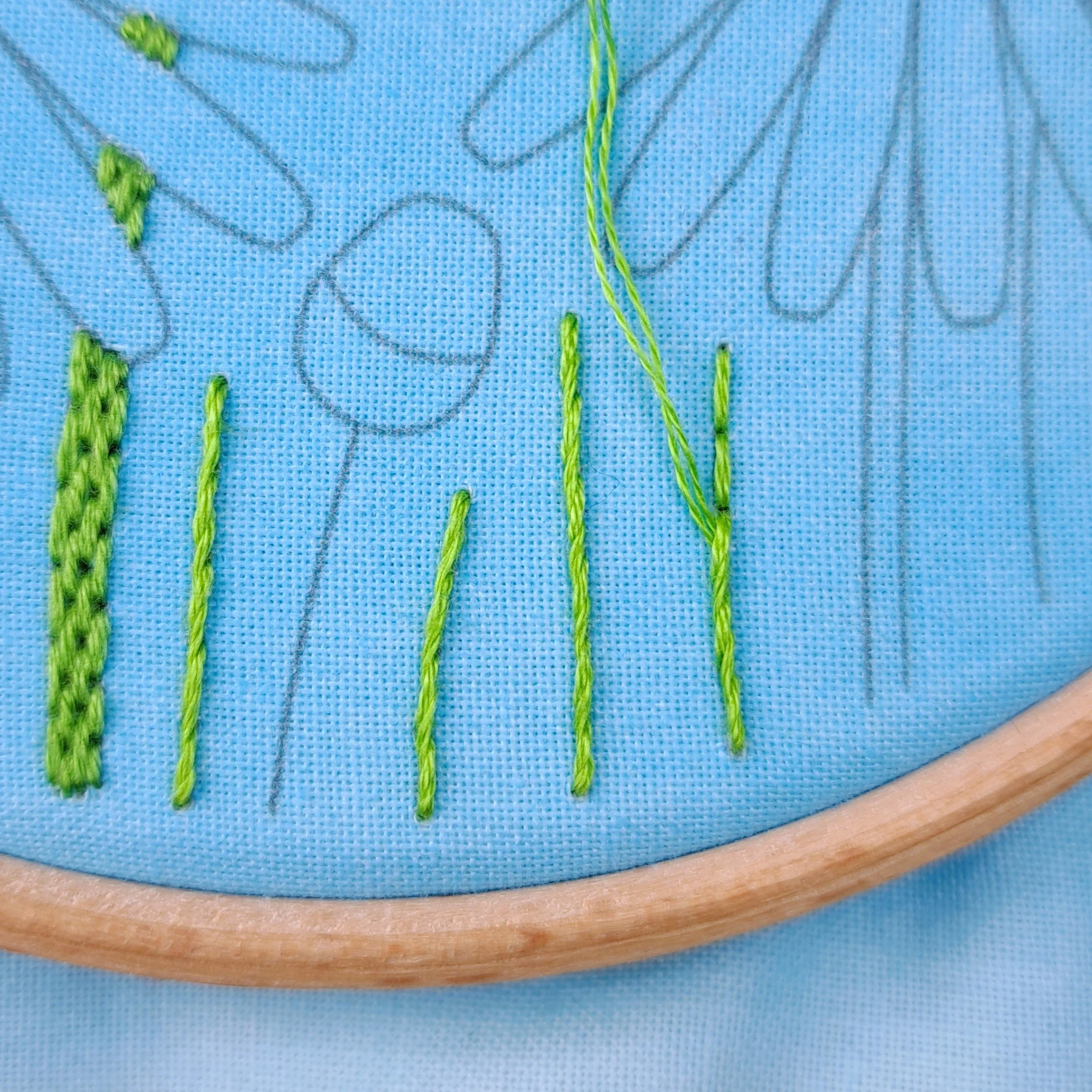
Ok, so straight up - a little confession… this isn’t actually where I started stitching (I began with the Echinaceas). But I stitched these grass blades using a single row of Whipped Backstitch, and it’s always much easier to do this when there aren’t lots of surrounding stitches to snag your needle on - so I thought I’d save you from that.
I’m right-handed and tend to whip my stitches from right to left, so I like to start with the grass blade furthest on the right and work my way across to the left.
Stitch - Whipped Backstitch
Thread colour - Anchor 238 (Grass Green)
Once stitched, this shade is quite subtly different from the green I used for the echinacea stems… maybe I should have picked something a bit more obviously different 🤔
Number of strands - 2
Needle size - Small
The Echinacea Stems
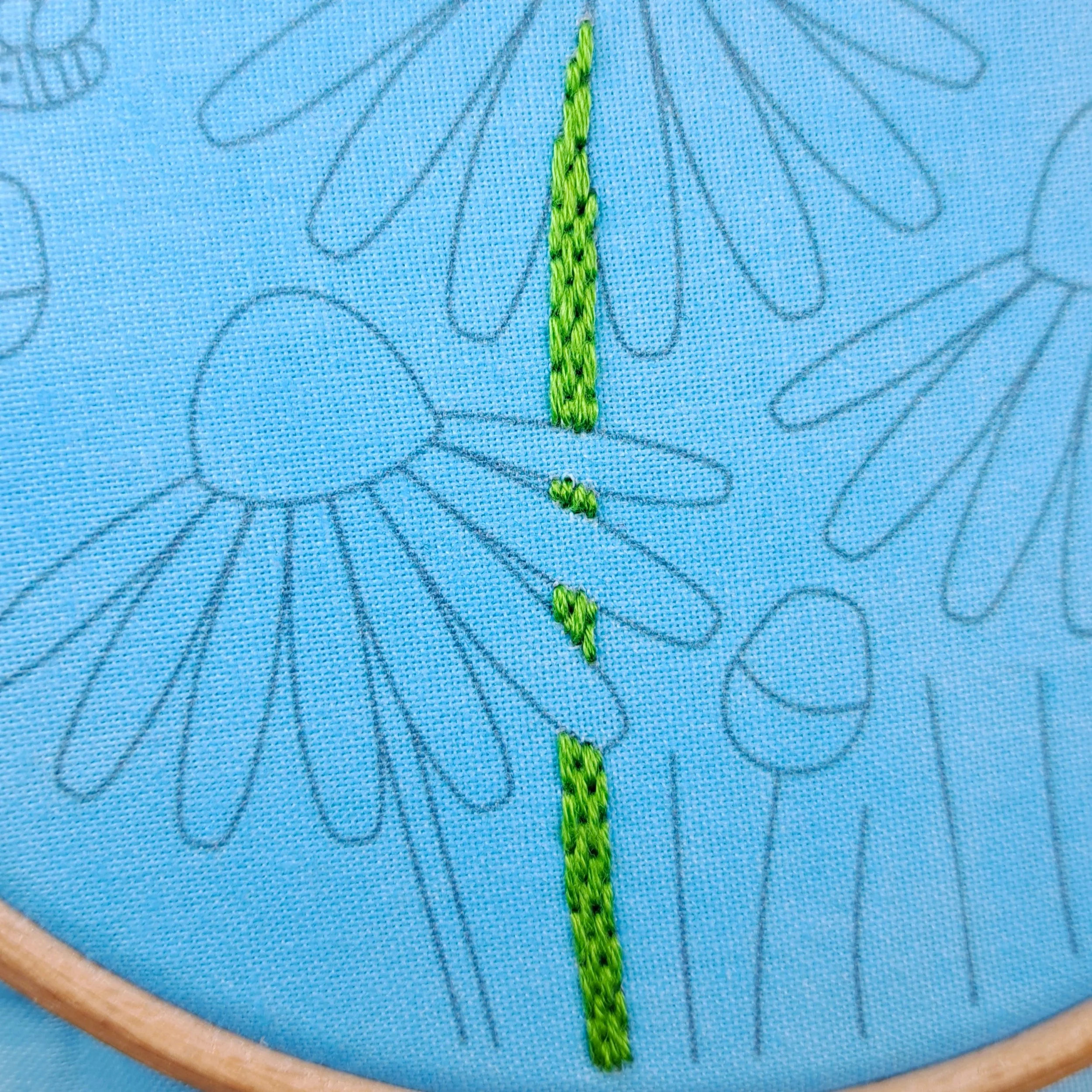
I stitched each of the stems using four vertical rows of Brick Stitch.
The only slightly tricky part here was keeping that lovely brick pattern going through the little sections where the stems disappear behind the petals. One of those areas was just too small to continue the pattern neatly, so I switched to a few Satin Stitches instead.
And honestly - once the petals were stitched over the top, you really can’t tell at all 😊
Stitch - Brick Stitch
Thread colour - Anchor 226 (Stem Green)
Number of strands - 3
Needle size - Medium
The Petals
I stitched all of my petals in the same way… but slightly differently for each flower - I was going for a “related but not twins” kind of look. You might decide to stitch yours all the same, or maybe make each one completely different.
I picked out four shades of pink from my stash for this. I chose them from a run of numbers - a light shade, a couple of mid tones, and a darker one - so they’re all in the same colour family and blend beautifully from light to dark.
My plan was to keep the darker shades closest to the centre of the flower, and the lightest shades towards the tips of the petals.
I also stitched my echinaceas one flower at a time (so petals, then centre, then onto the next), but just to keep things simple, I’ll walk you through all of the petals first.
I’ll explain exactly how I used the colours for each flower…
Stitch - Satin Stitch
Thread colours - Anchor 50 (Pale Pink), 52 (Light Pink), 54 (Pink), 58 (Dark Pink)
Number of strands - 3
Needle size - Medium
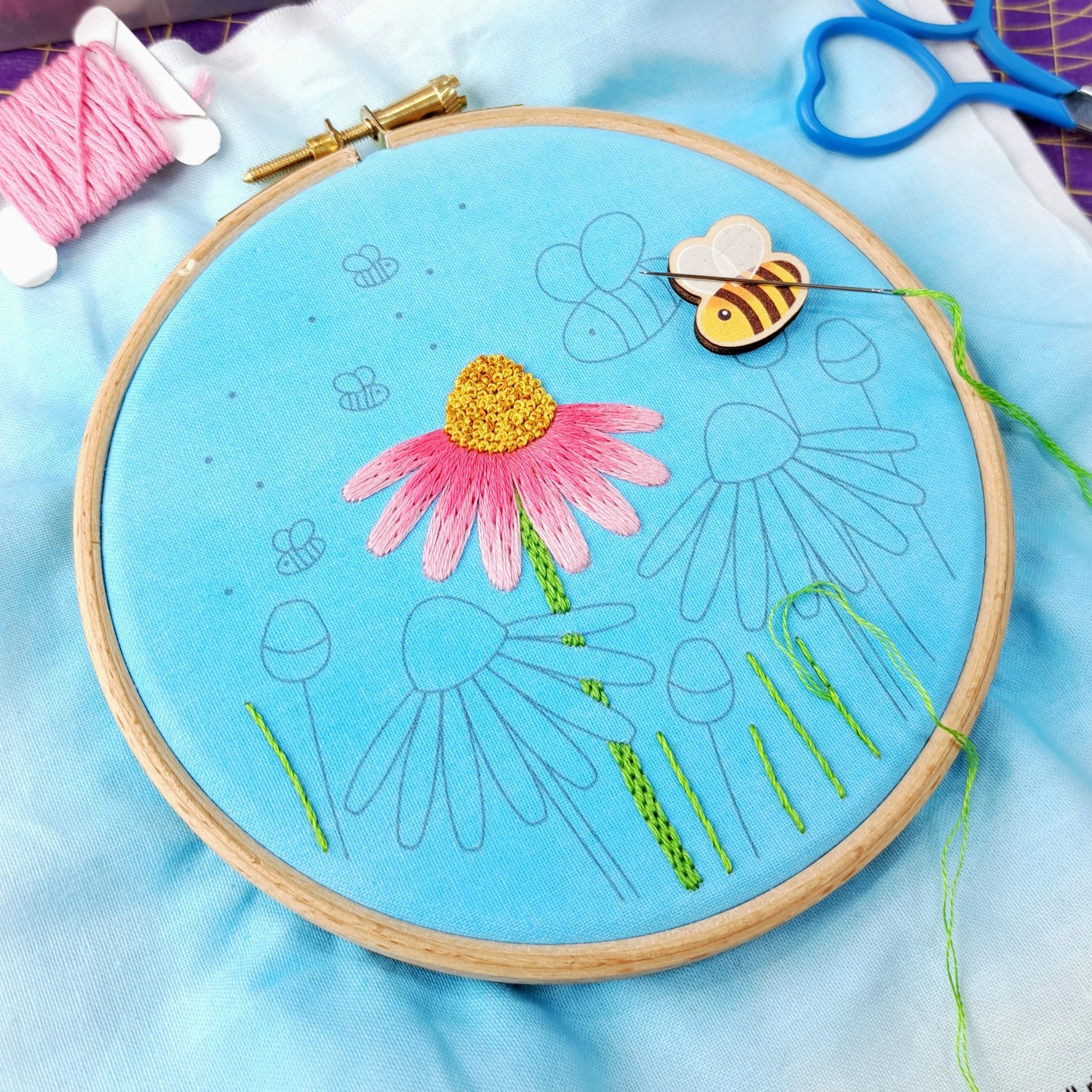
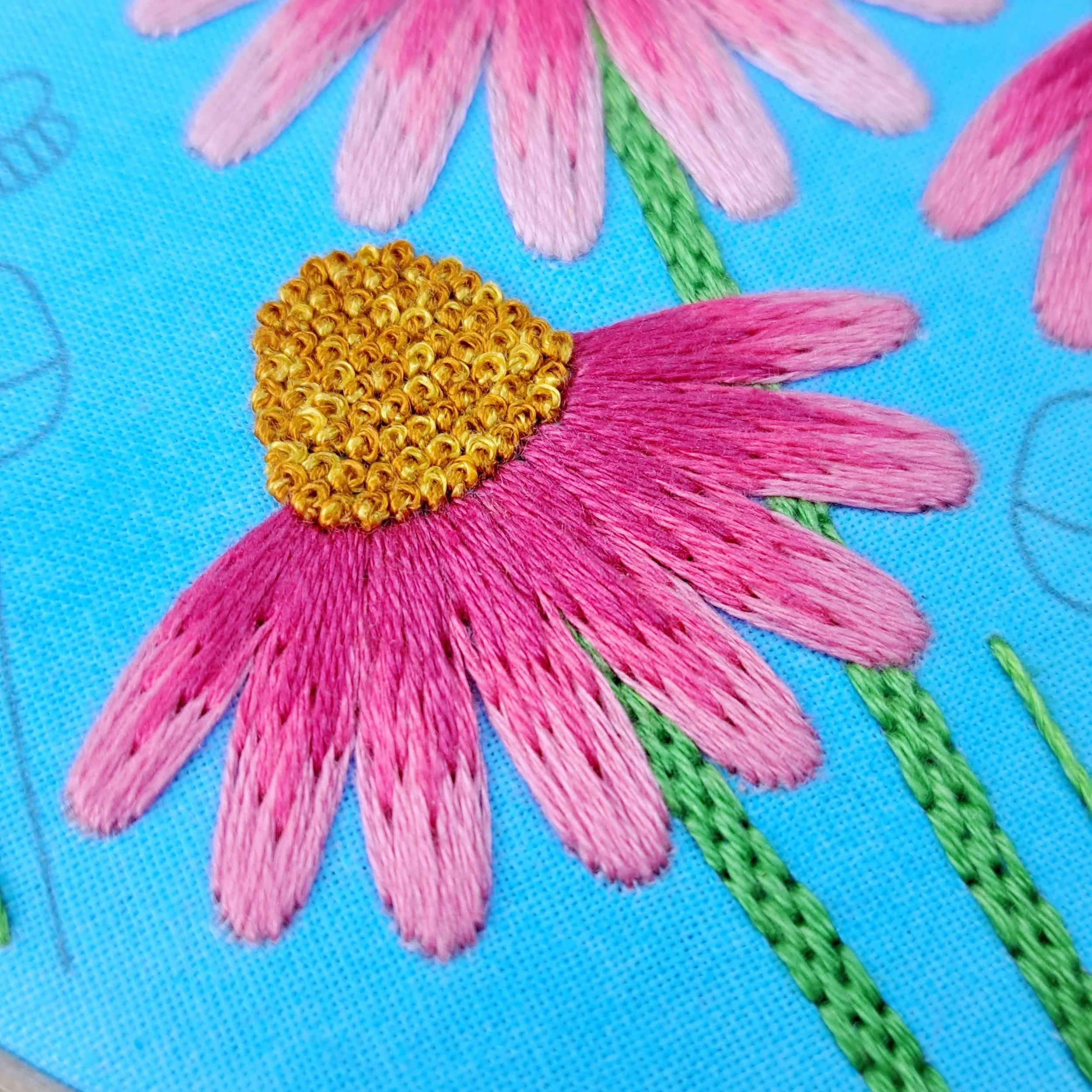
The Middle Echinacea Petals
I started by drawing guide lines onto each petal to help guide the colour blending. I drew two lines on each petal to divide them into three sections.
I usually use a fabric pen for this, but I’d left mine in the studio and was stitching in the living room… and honestly, I was too comfy to go and get it 🙈 So I used an ordinary pencil instead, knowing the lines would be completely covered. I just made sure to draw them on lightly and carefully.
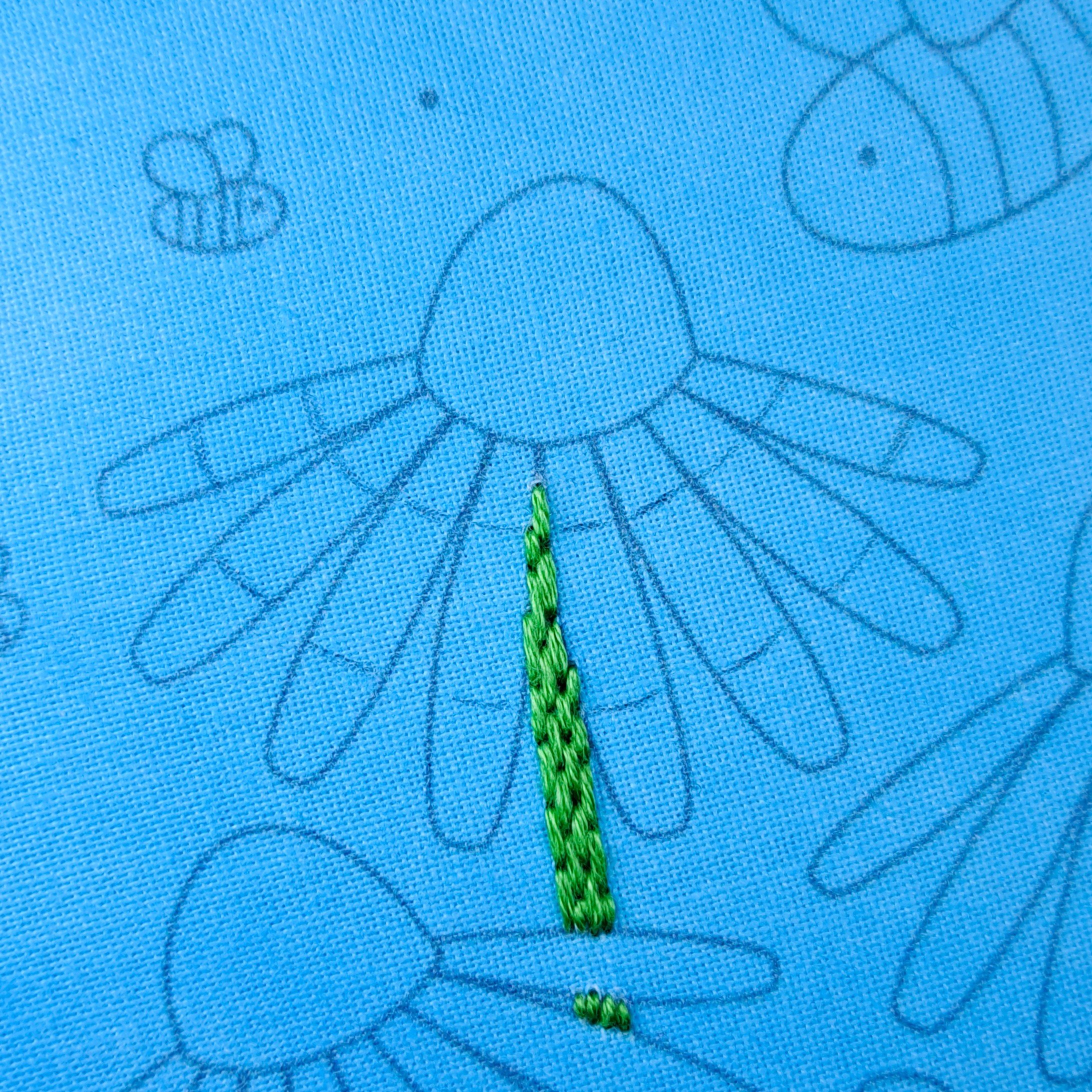
For this flower, I used these three shades:
Anchor 50 (Pale Pink), 52 (Light Pink), and 54 (Pink)
Step 1 – Outer section
I started by stitching the outer section of each petal with Satin stitch using Anchor 50 (Pale Pink). I extended these stitches about halfway into the next section - the more you overlap, the softer the blend will be.
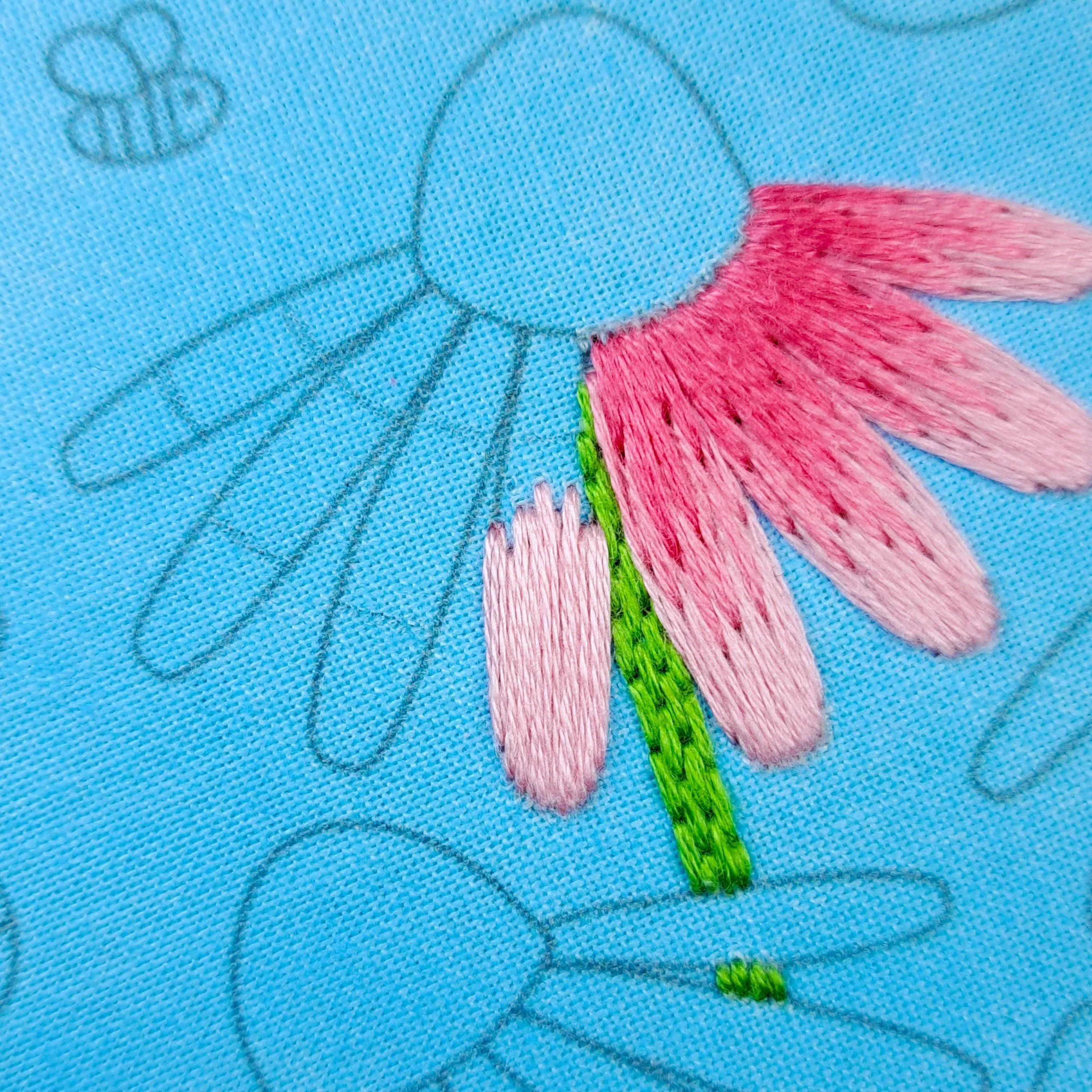
Step 2 – Middle section
Next, I filled the middle section with Anchor 52 (Light Pink). I stitched from about halfway in the inner section and extended the stitches back into the outer section.
I placed these stitches into outer section stitches (to split the stitches rather than going in between them) and stitched them at varying lengths - the more uneven these lengths are, the more natural and blended the petals will look.
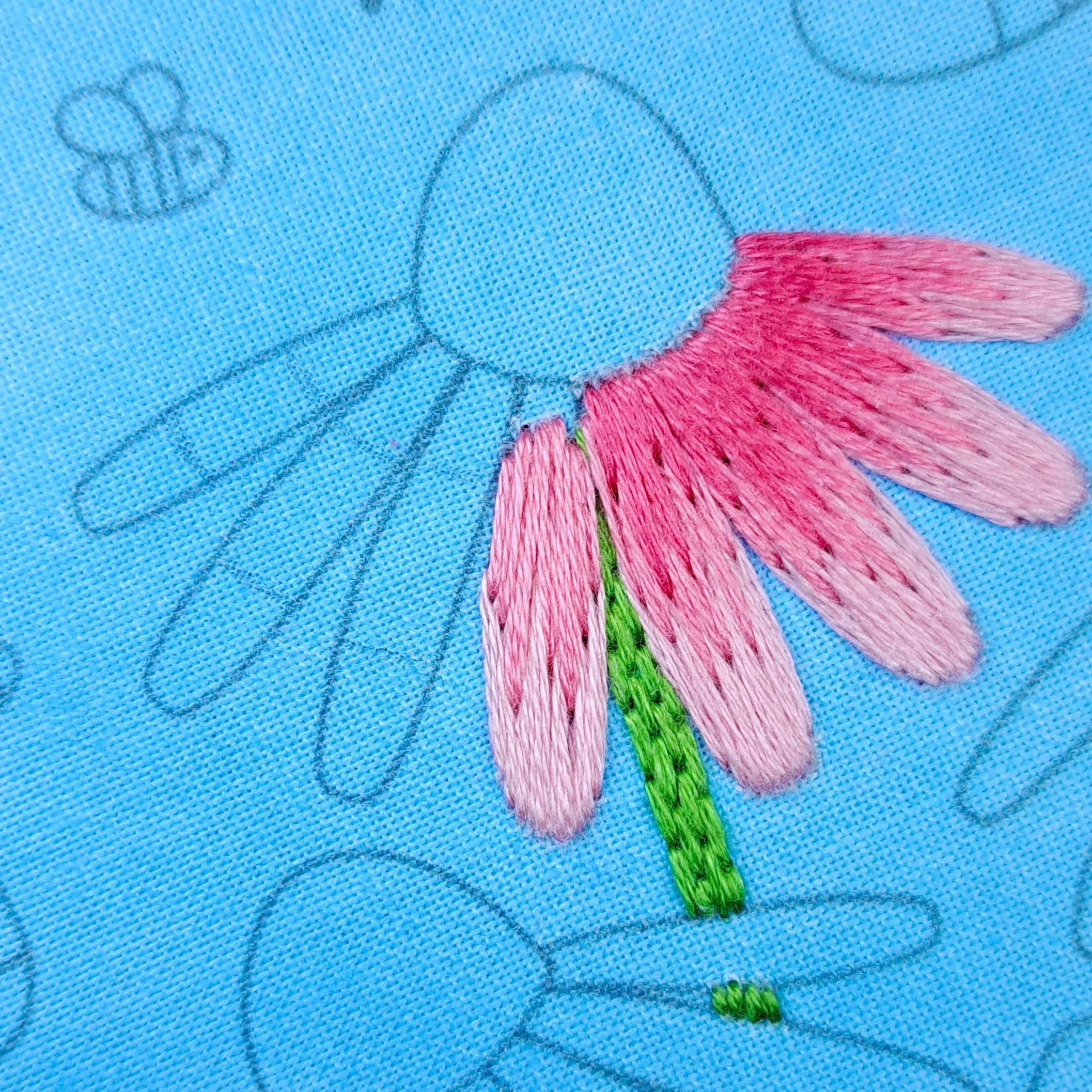
Step 3 – Inner section
Finally, I filled the inner section using Anchor 54 (Pink). These stitches started from the centre of the flower and extended out into the middle section, again at varying lengths.
Some of my longest stitches reached about halfway down the petal.
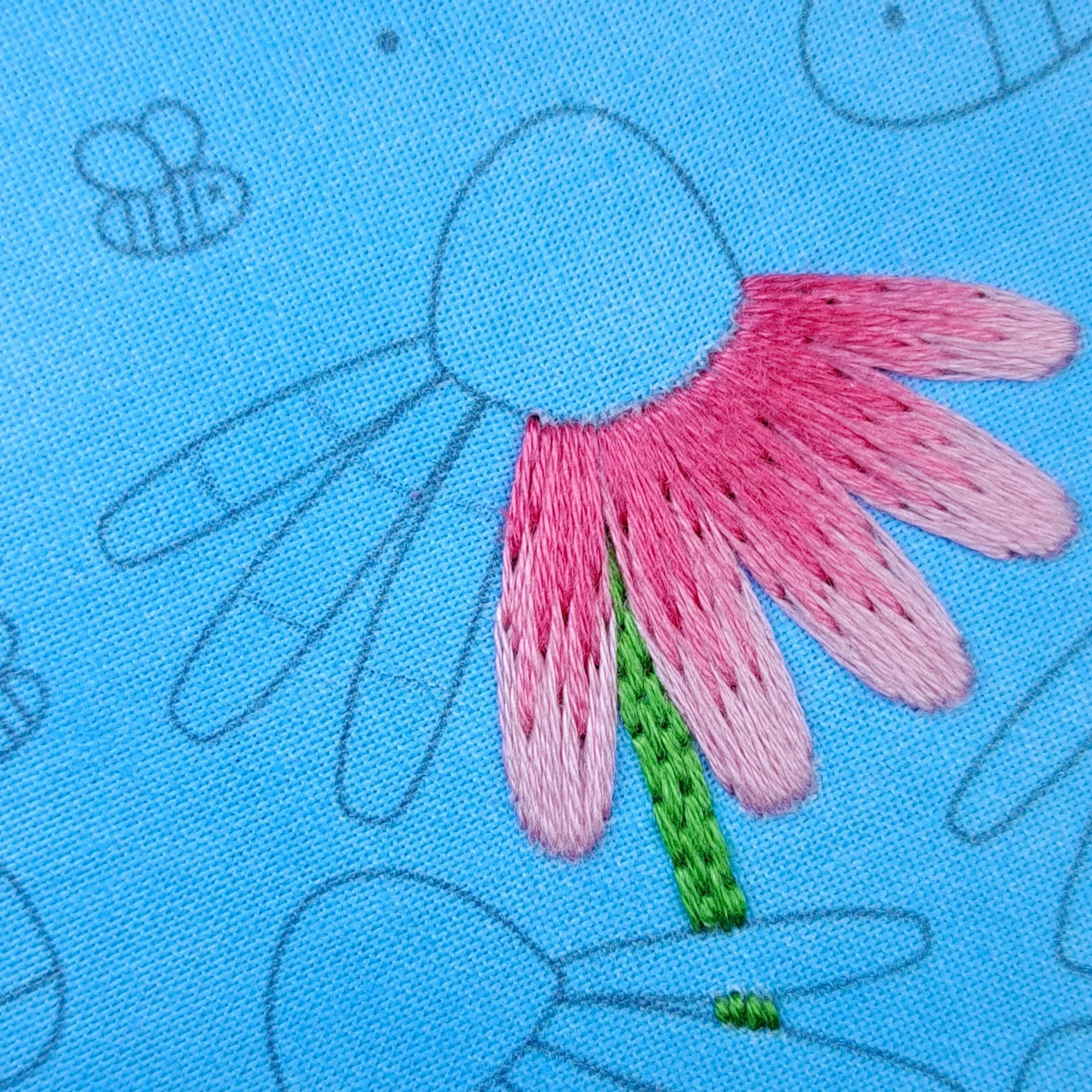
The Left Echinacea Petals
I stitched these in exactly the same way as the middle flower, but I used different shades of pink to create a darker flower.
This time I used:
Anchor 52 (Light Pink) – for the outer section
Anchor 54 (Pink) – for the middle section
Anchor 58 (Dark Pink) – for the centre section
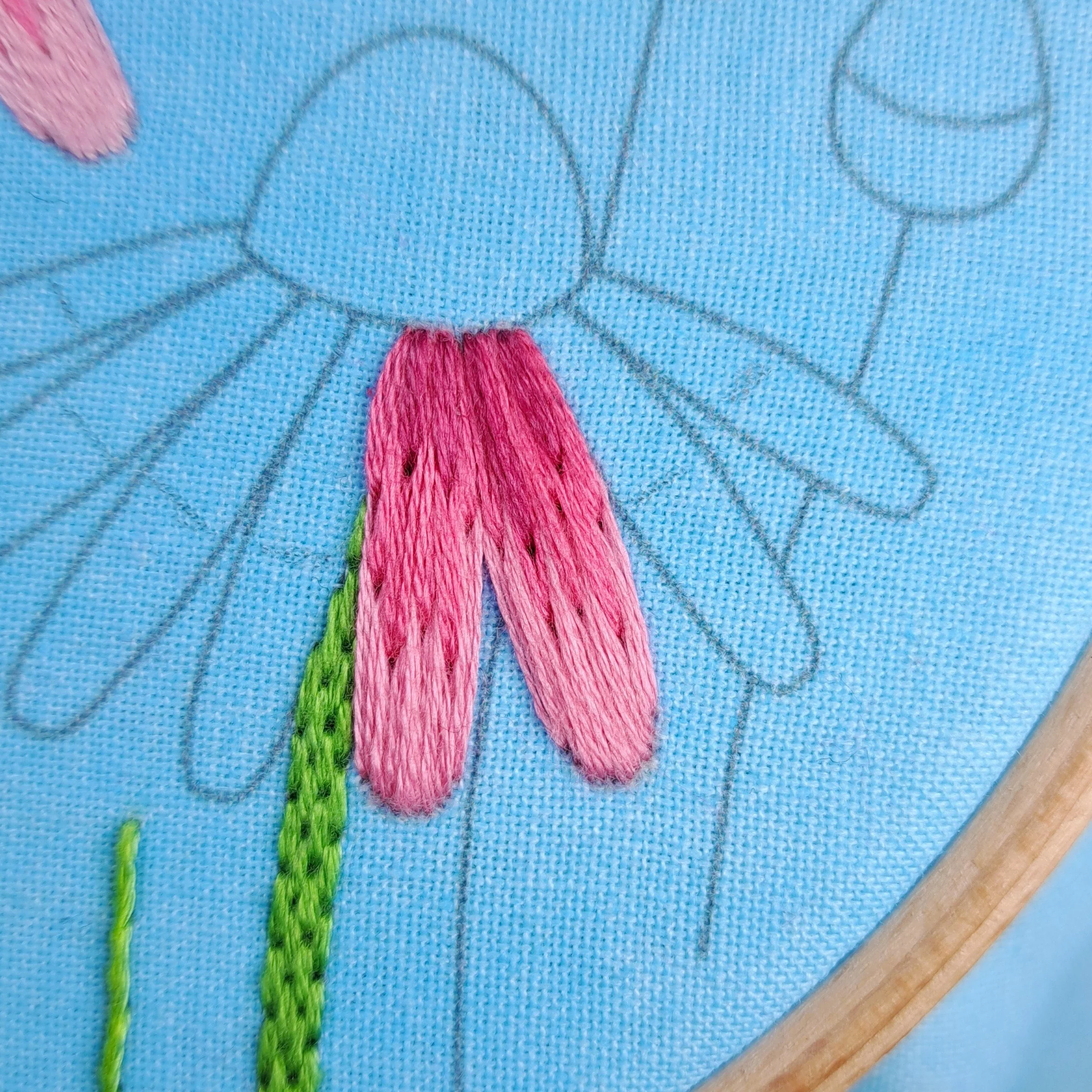
The Right Echinacea Petals
For this flower, I did something slightly different.
Instead of dividing the petals into three sections, I used just two:
Anchor 52 (Light Pink) – outer section
Anchor 54 (Pink) – centre section
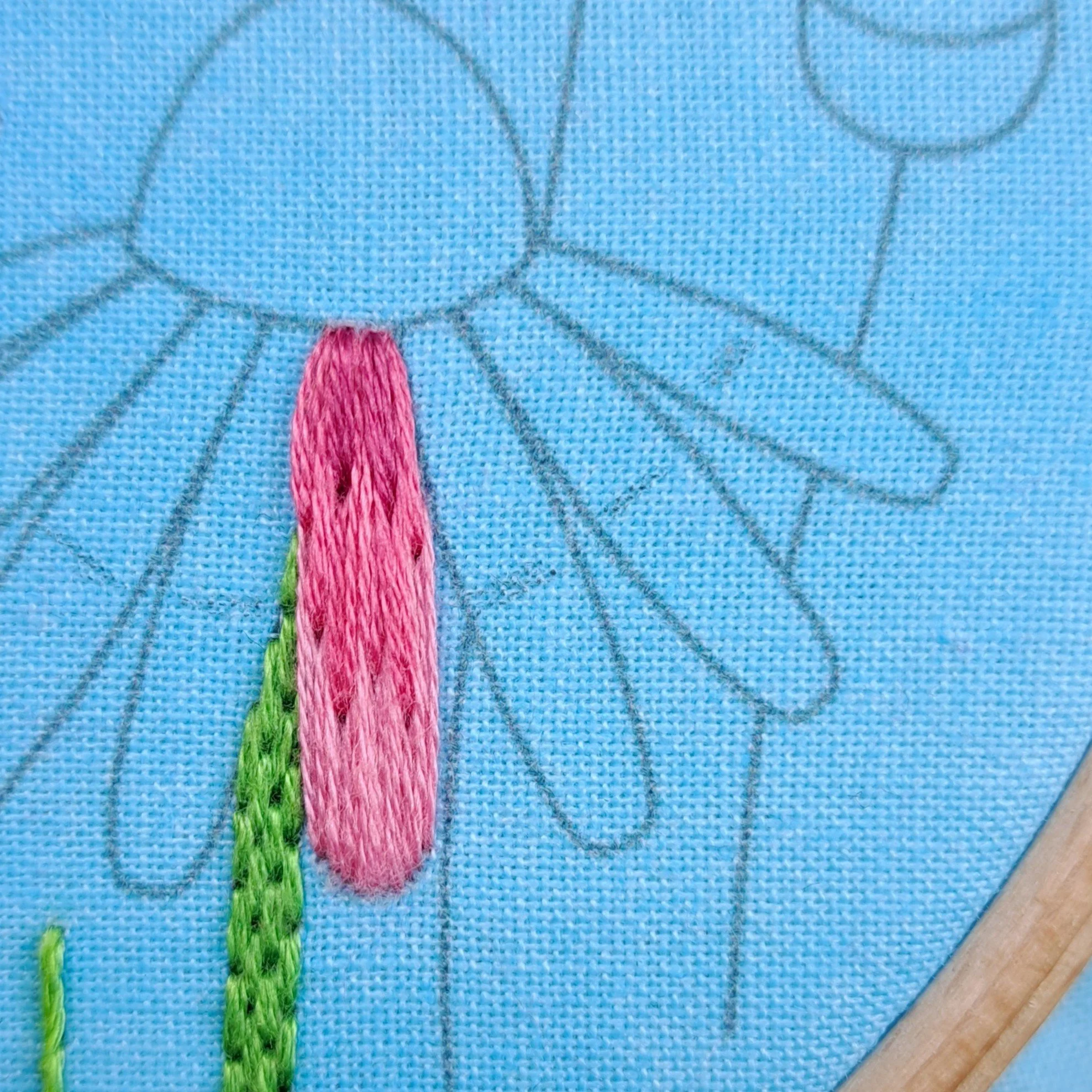
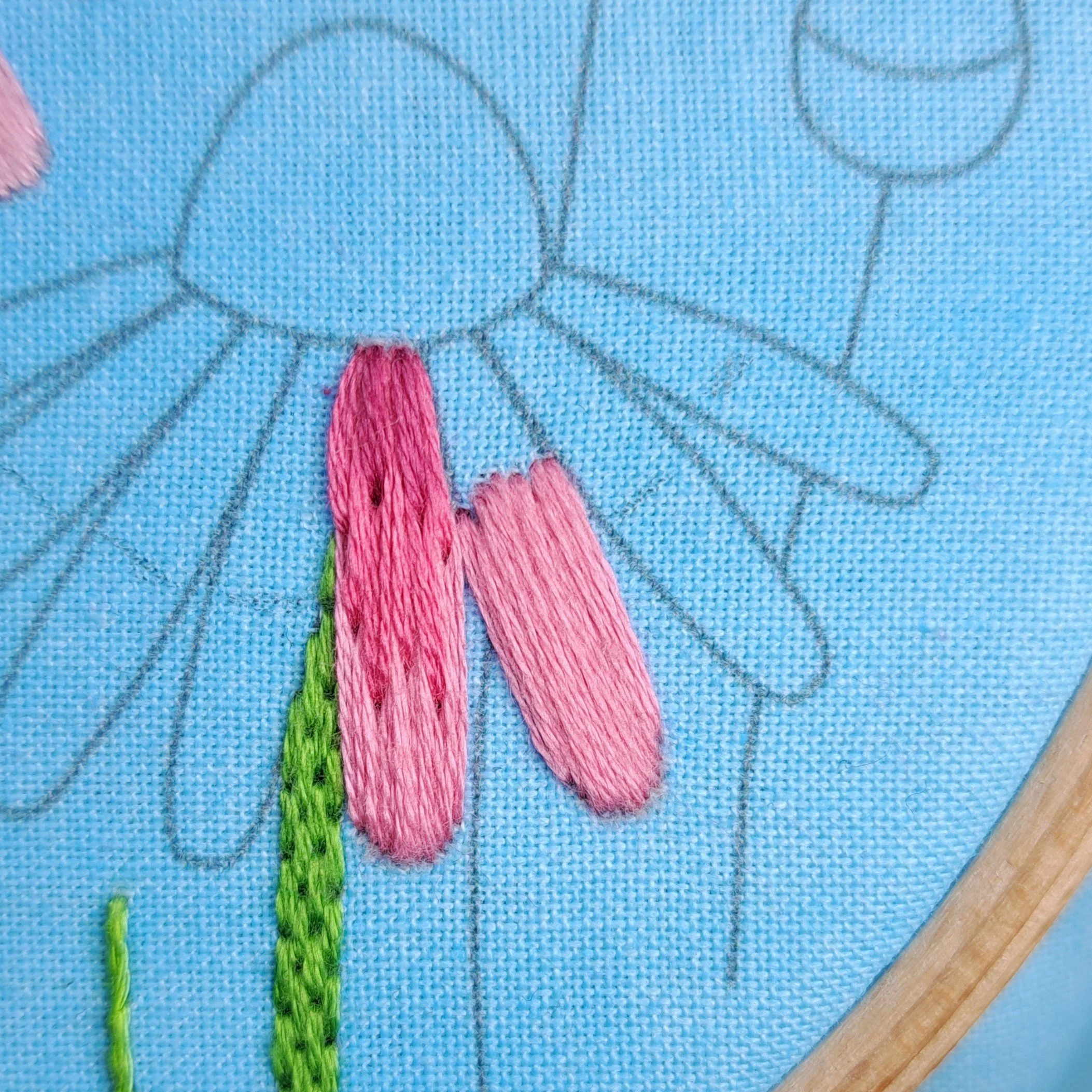
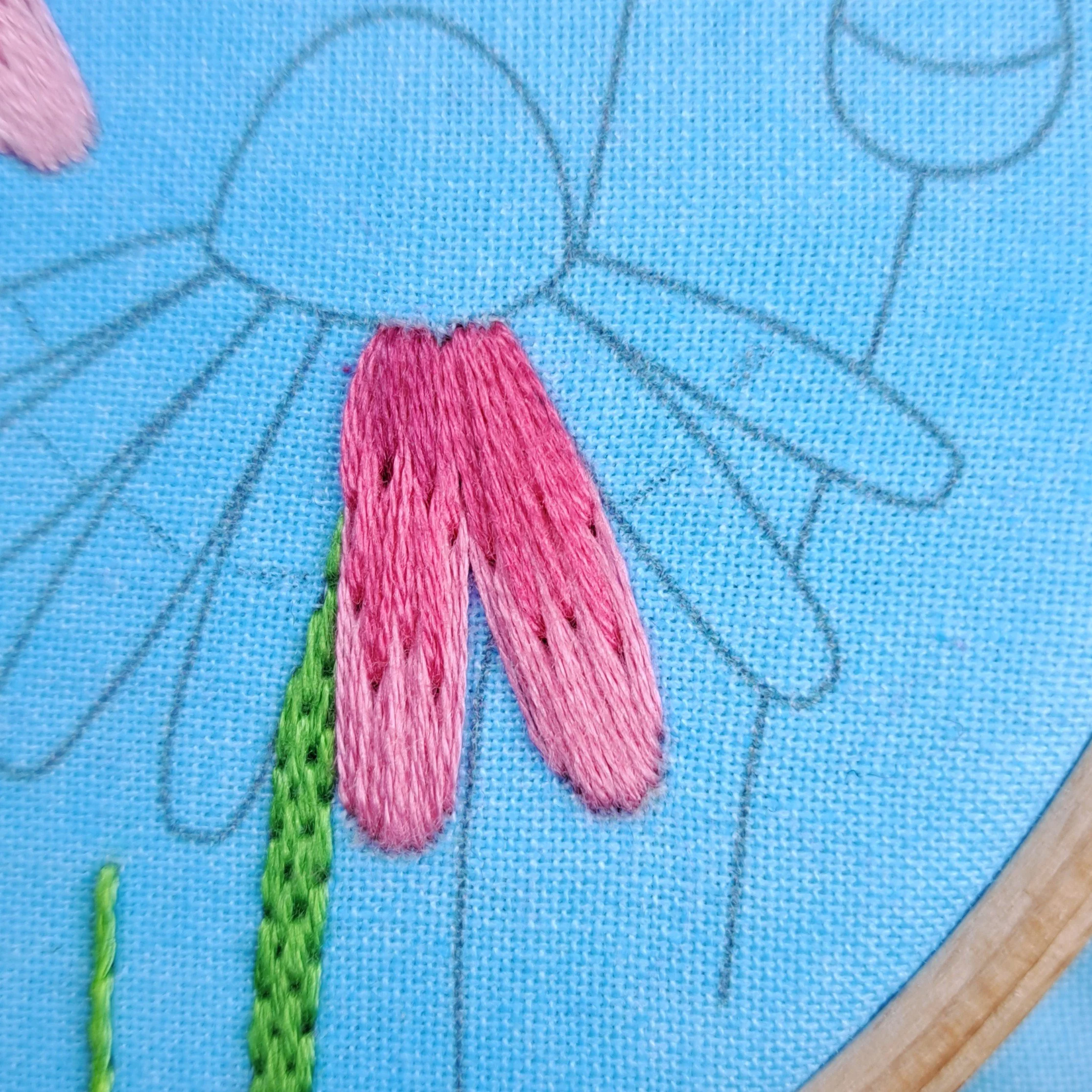
Once the petals were filled, I added a couple of straight stitches using Anchor 58 (Dark Pink) into each petal.
These stitches started from the flower centre and stitched at varying lengths, with the longest reaching about halfway down the petals.
The Flower Centres
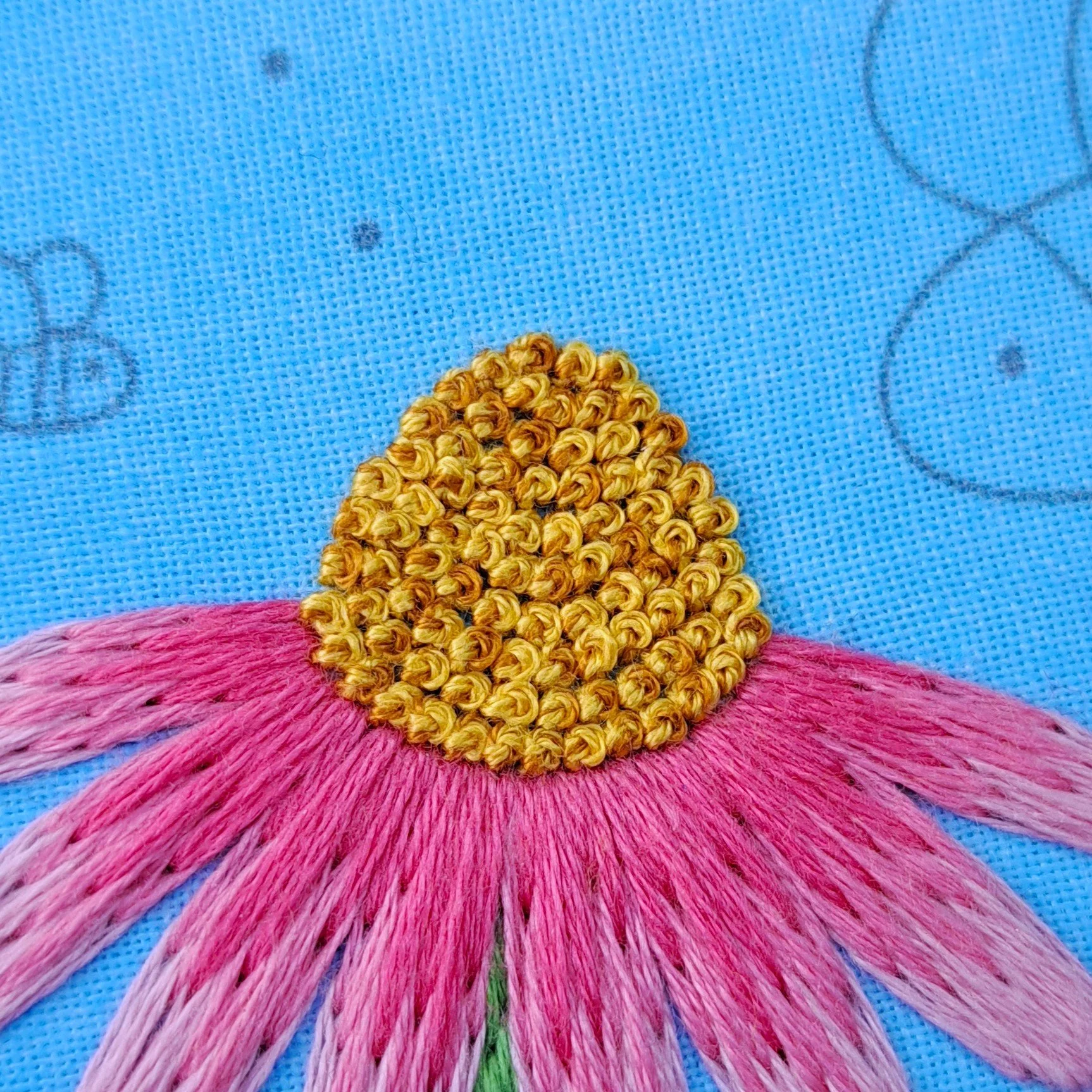
I filled all of the flower centres with French knots (2 wraps) using 3 strands of thread.
For this, I combined strands of both DMC 728 (Golden Yellow) and Anchor 308 (Copper) and stitched with them together. Stitching with two colours like this creates such a lovely textured effect - I really love how this turned out! 😍
For the middle and right echinaceas, I used:
2 strands of DMC 728 (Golden Yellow) with
1 strand of Anchor 308 (Copper)
For the left echinacea, I switched it slightly to make a darker version for this flower:
2 strands of Anchor 308 (Copper) with
1 strand of DMC 728 (Golden Yellow)
I stitched my French knots in horizontal rows, following the bottom curve of the centre - starting at the base and working my way up to the top.
Stitch – French Knots with 2 wraps
Thread colours – DMC 728 (Golden Yellow) and Anchor 308 (Copper)
Number of strands – 3
Needle size – Medium

✨ Enjoying the blog so far?
I’ve poured a lot of time and stitches into this one, so if you’re finding it helpful and fancy leaving a little Ko-fi tip, that would be amazing - but absolutely no pressure 💛
Now back to the stitching…
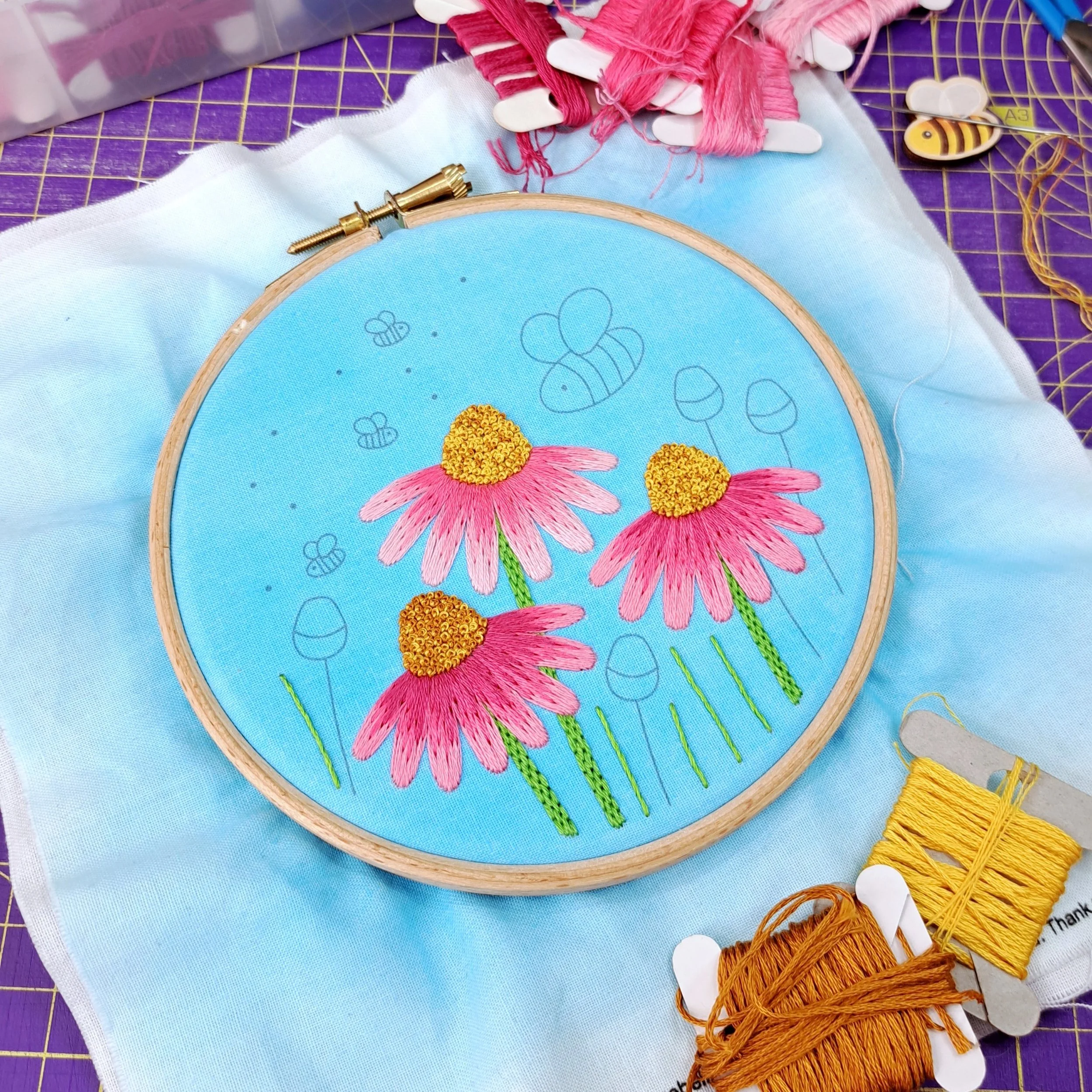
At this point, I was really itching to start the bees…
And I absolutely could have (you could too!), but I decided to finish all of the flower parts first - just in case it changed how I wanted to stitch the bees.
The Flower Buds (the top parts)
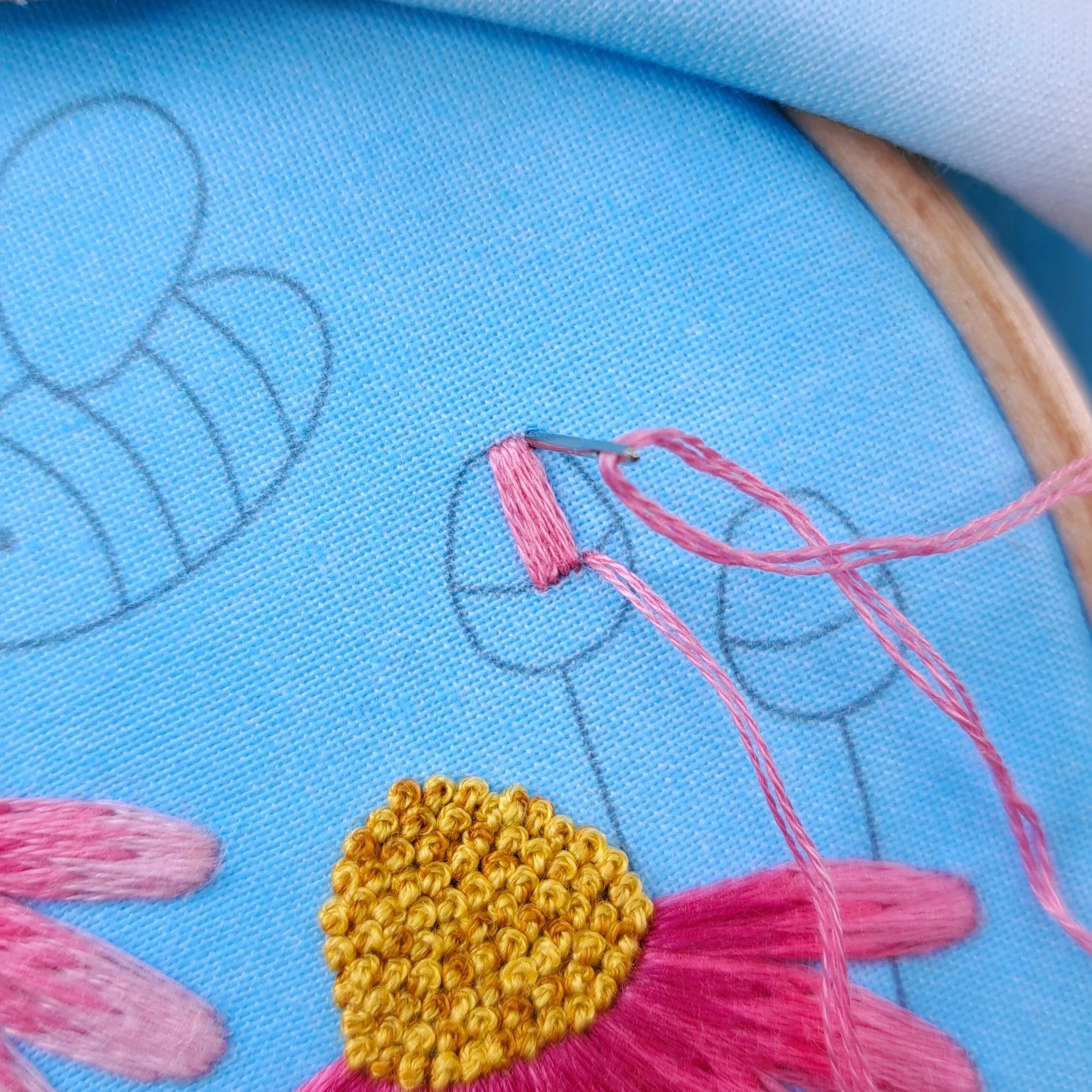
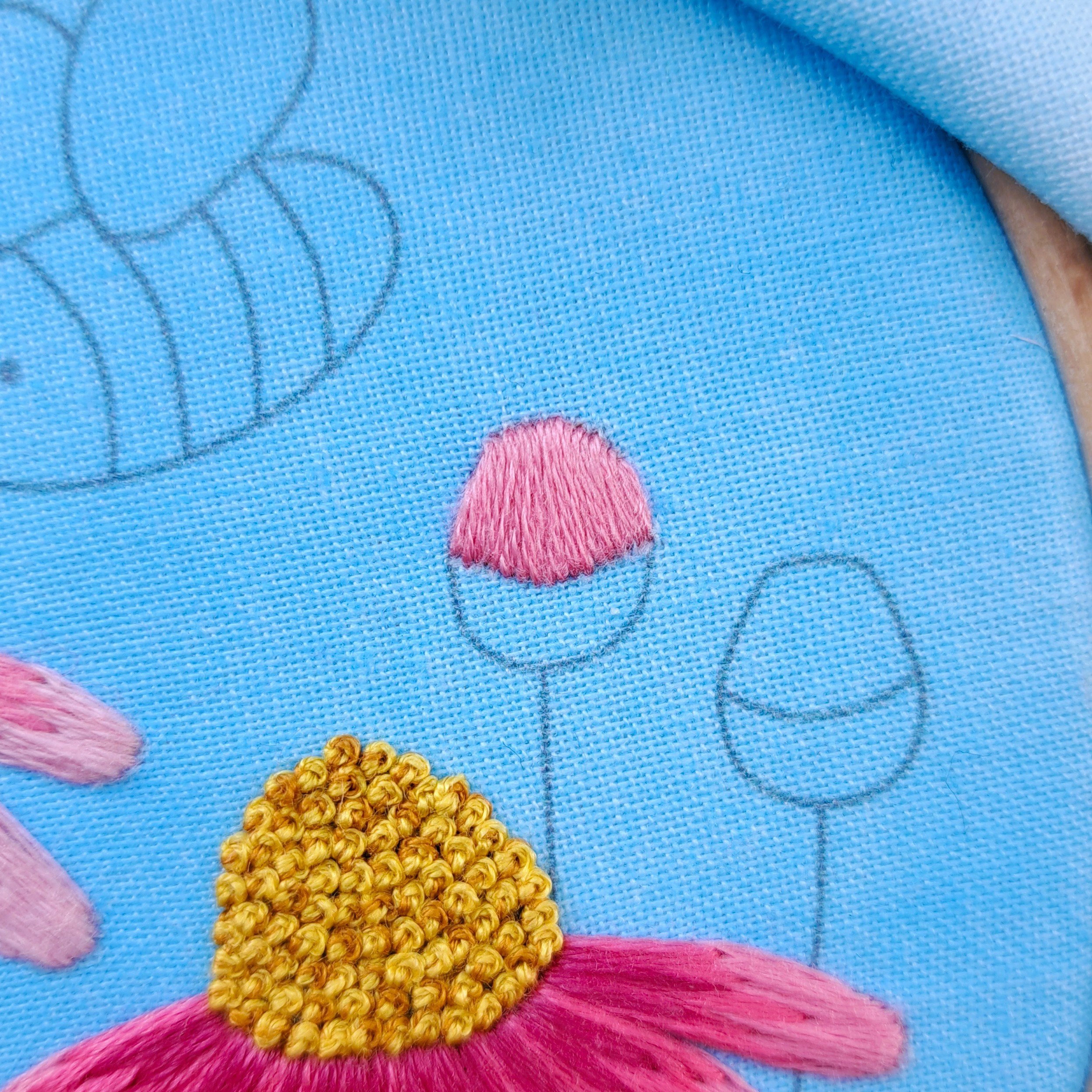
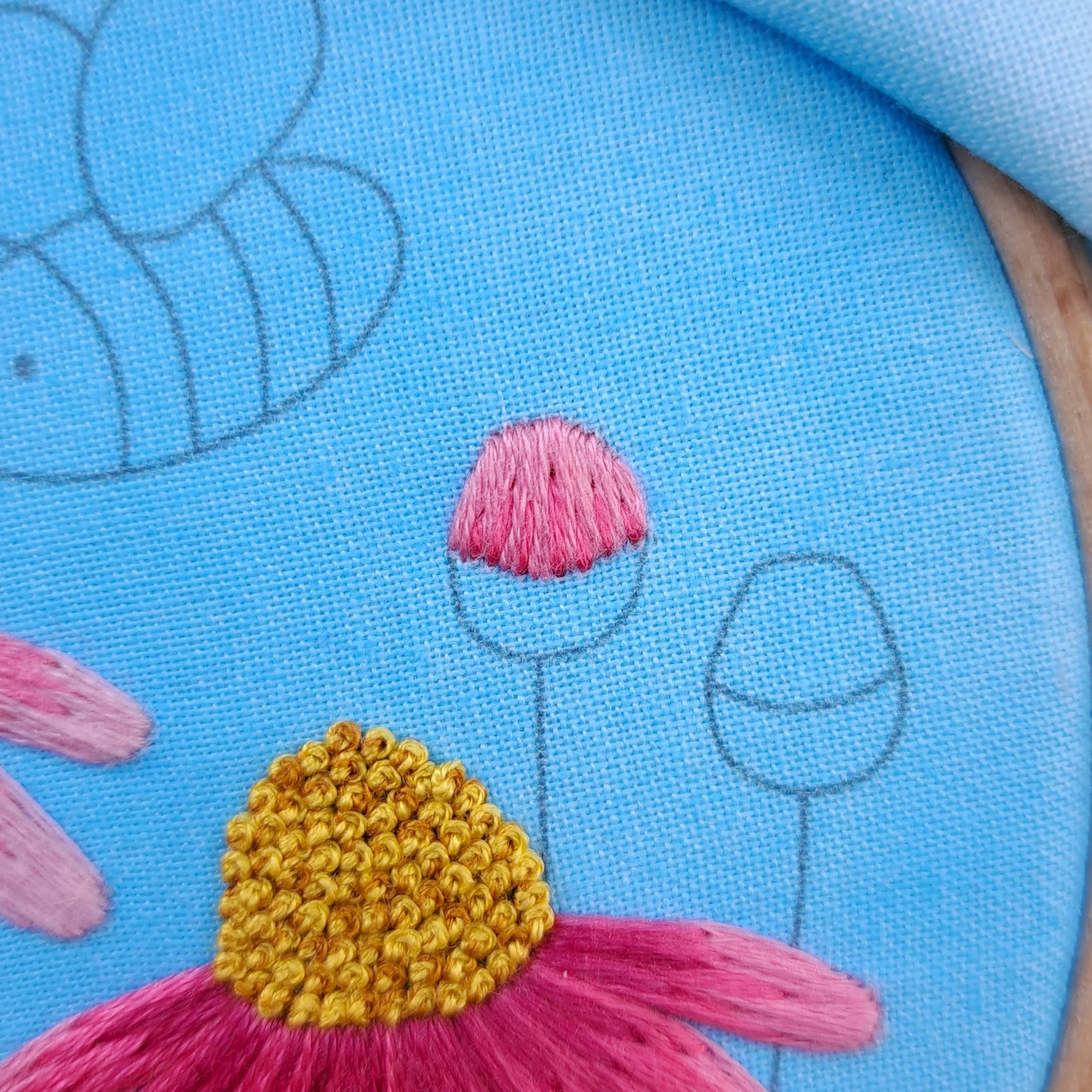
I filled the top sections of the buds with Satin Stitch using 3 strands. Then I added a few Straight Stitches over the top using 2 strands, stitching them at varying lengths.
You can add as many of these straight stitches as you like - I stitched around 6 into each bud.
I did use a couple of colour variations here (I know… this has definitely become a bit of a theme 😄) to create a lighter bud and a slightly darker one, and then alternated between them.
For the darker buds, I used:
Anchor 52 (Light Pink) – Satin Stitch
Anchor 54 (Pink) – Straight Stitches
For the lighter buds, I used:
Anchor 50 (Pale Pink) – Satin Stitch
Anchor 52 (Light Pink) – Straight Stitches
✨ A Little Tip:
I like to place my very first Satin Stitch right down the centre of the shape, then stitch outwards one side at a time. It really helps keep the stitches at a consistent angle.
Stitch – Satin Stitch and Straight Stitch
Thread colour – Anchor 50 (Pale Pink), 52 (Light Pink), 54 (Pink)
Number of strands – 3 (Satin Stitch), 2 (Straight Stitch)
Needle size – Medium and Small
The Bud Stems
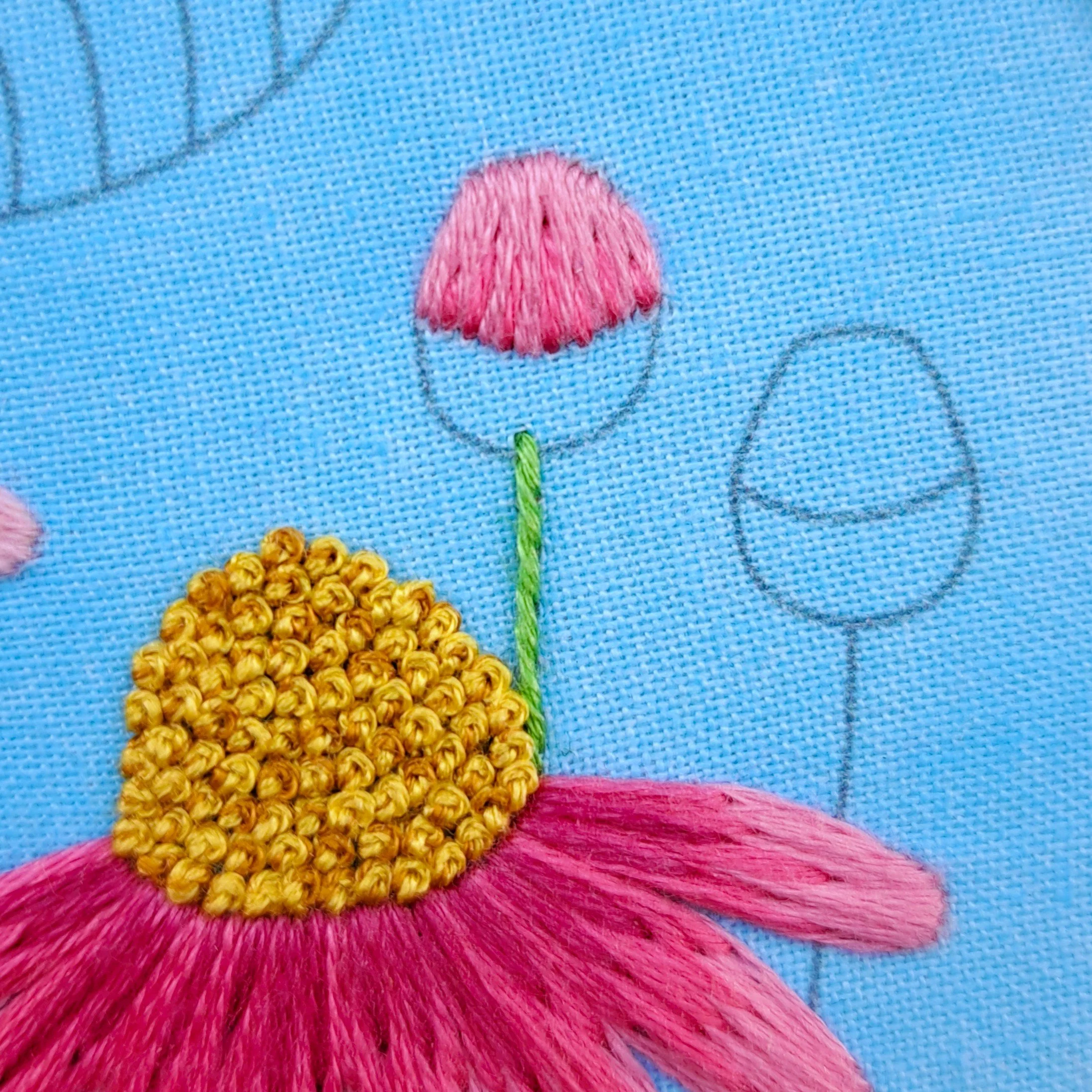
Before stitching the bottom section of each bud, I stitched the stems using a single row of Stem Stitch.
I extended each stem slightly into the base of the bud - just a little. We’ll stitch over this in the next step, and I find it gives a much neater finish than stopping the stem right where it meets the bud.
✨ A Little Tip:
For the stems on the right-hand side (the ones that sit behind the petals we’ve already stitched), angle your needle slightly so you can tuck the stitches neatly behind the petal stitches.
Stitch – Stem Stitch
Thread colour – Anchor 226 (Stem Green)
Number of strands – 3
Needle size – Medium
The Flower Buds (the bottom parts)
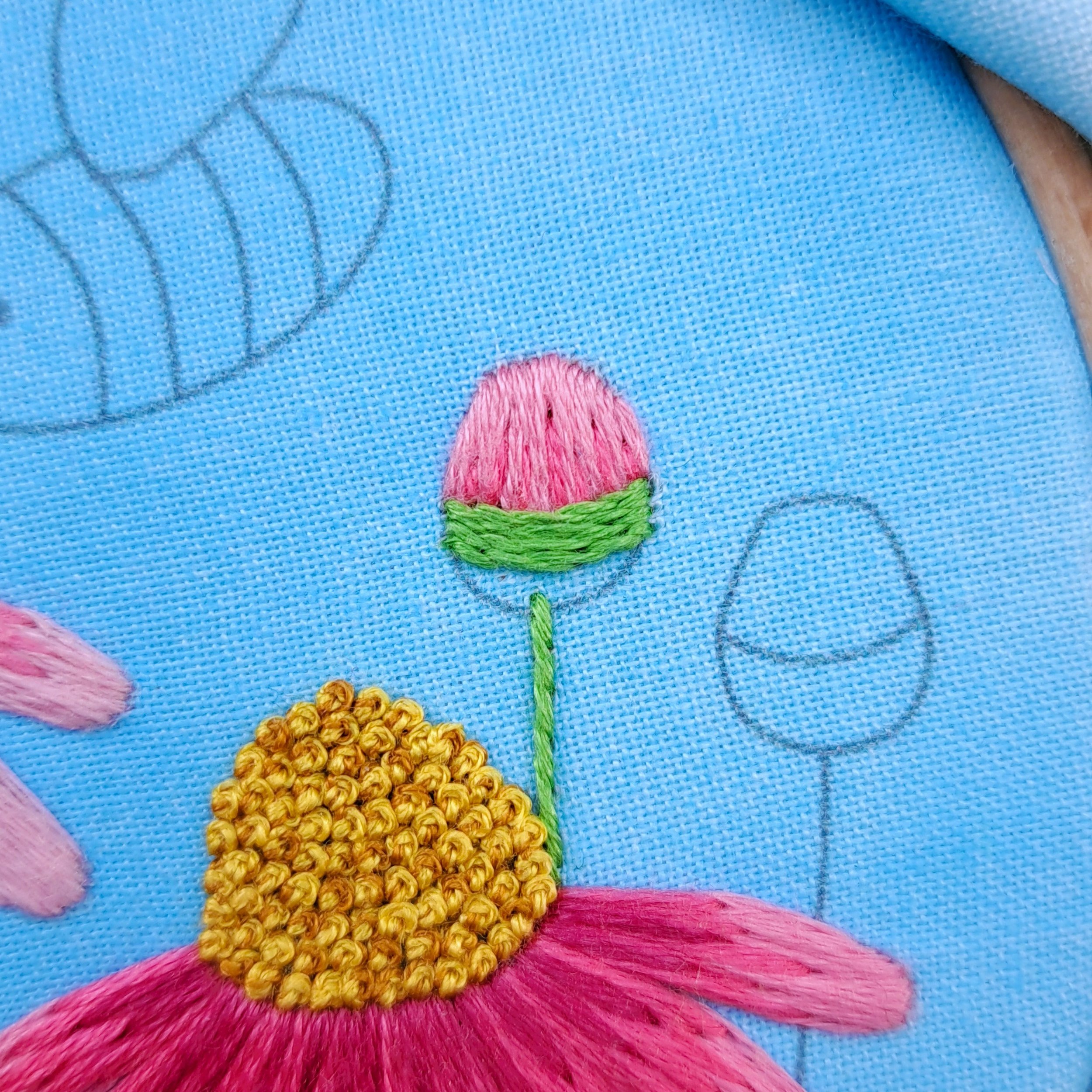
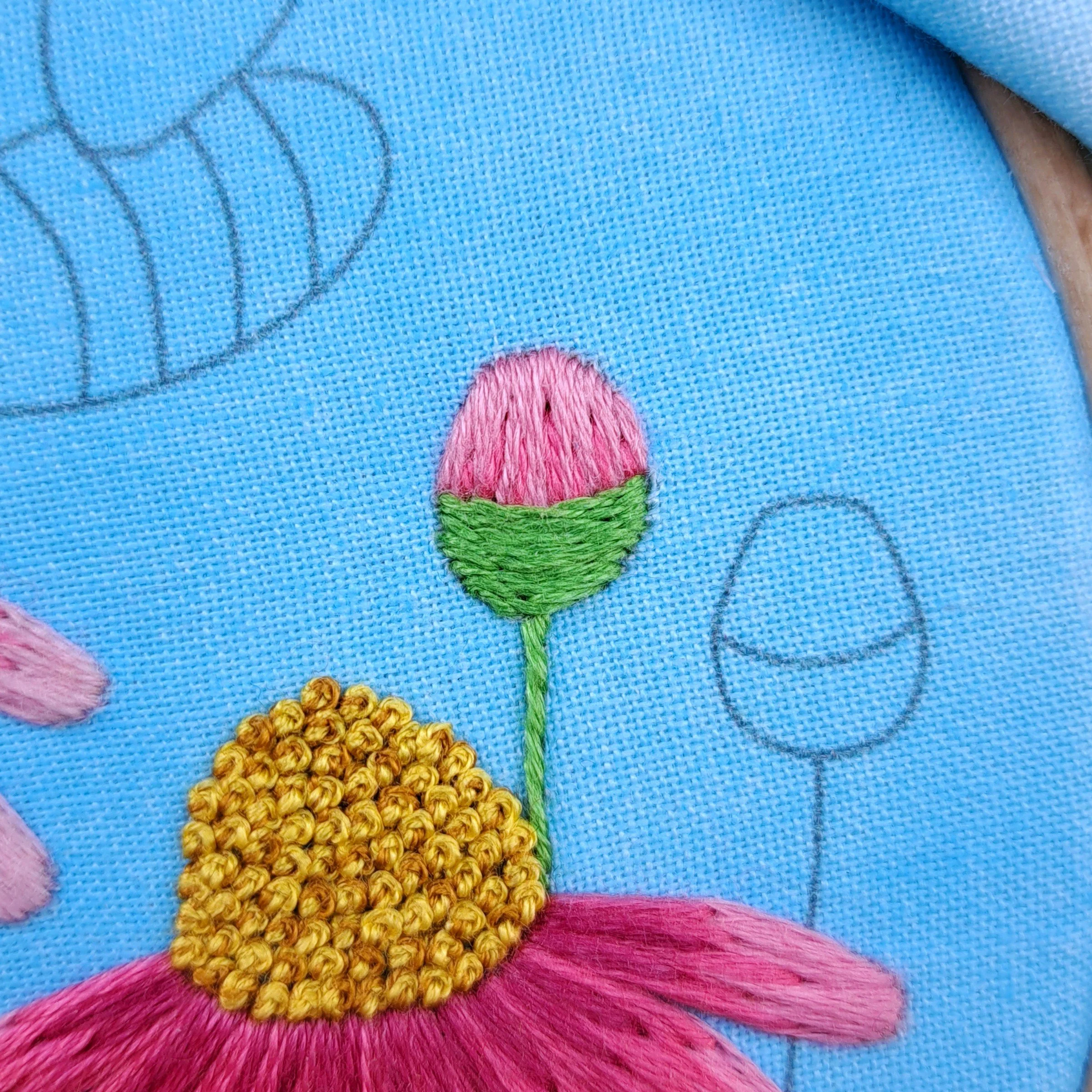
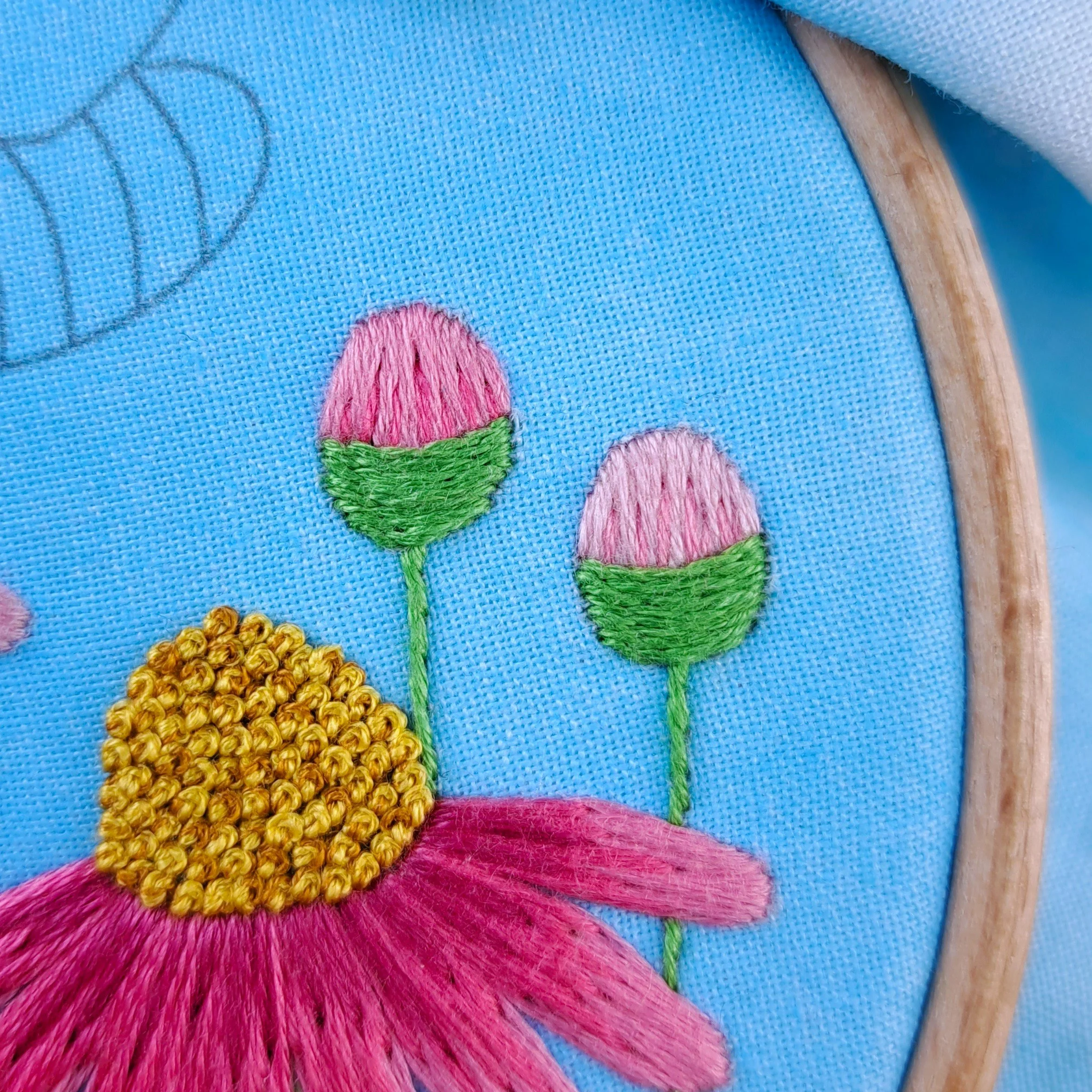
I filled the bottom section of each bud with horizontal rows of Stem Stitch.
I stitched the first row at the top of the section, following that curved line that divides the top and bottom of the bud. Then I worked my way down, keeping each row nicely curved to match the shape.
When I reached the bottom, I stitched the final row straight over the top of the stem to hide it neatly.
Stitch – Stem Stitch
Thread colour – Anchor 226 (Stem Green)
Number of strands – 3
Needle size – Medium
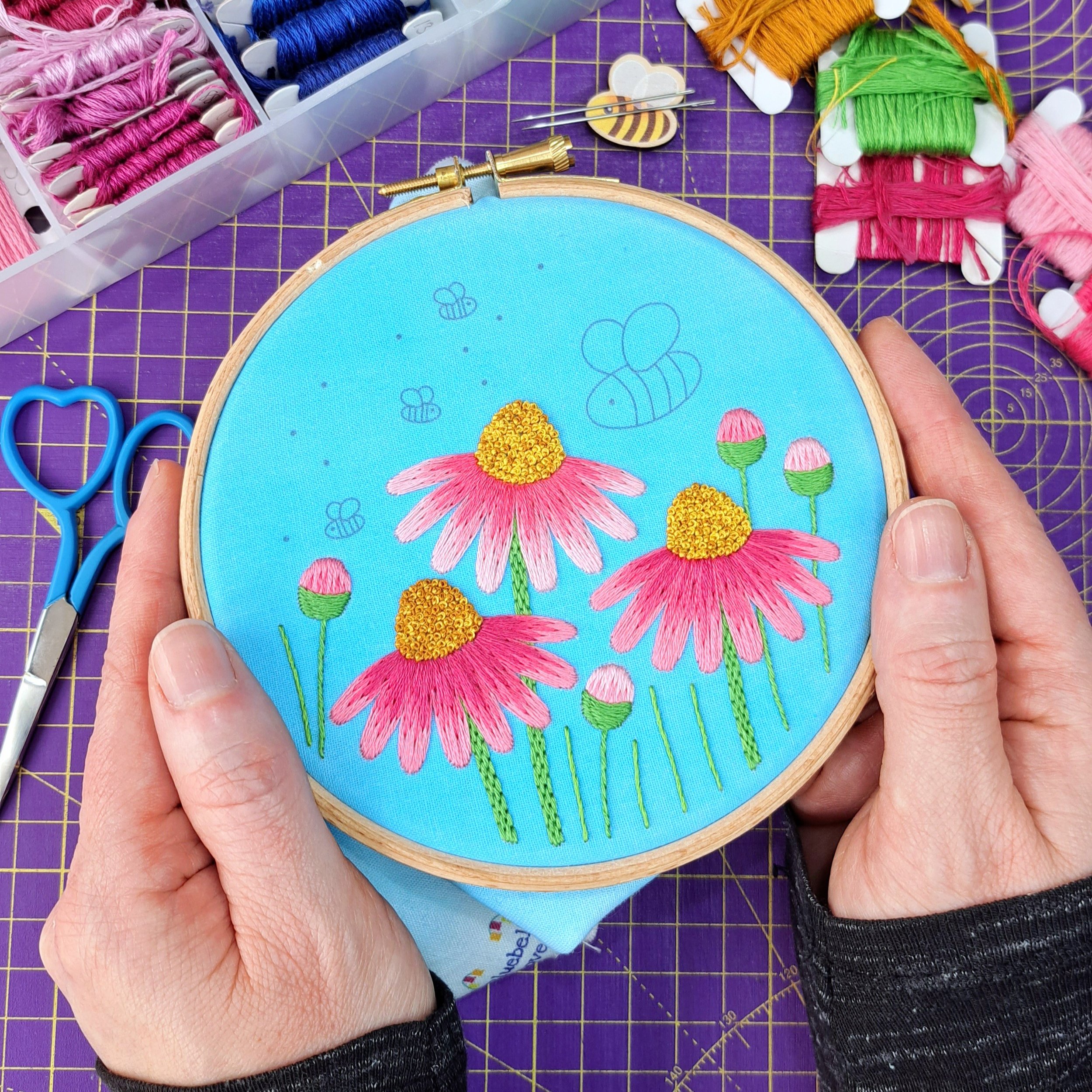
So that’s all of the flowers and buds stitched - just the bees to go! And I started with the biggest bee first 😃
The Big Bee - Wing
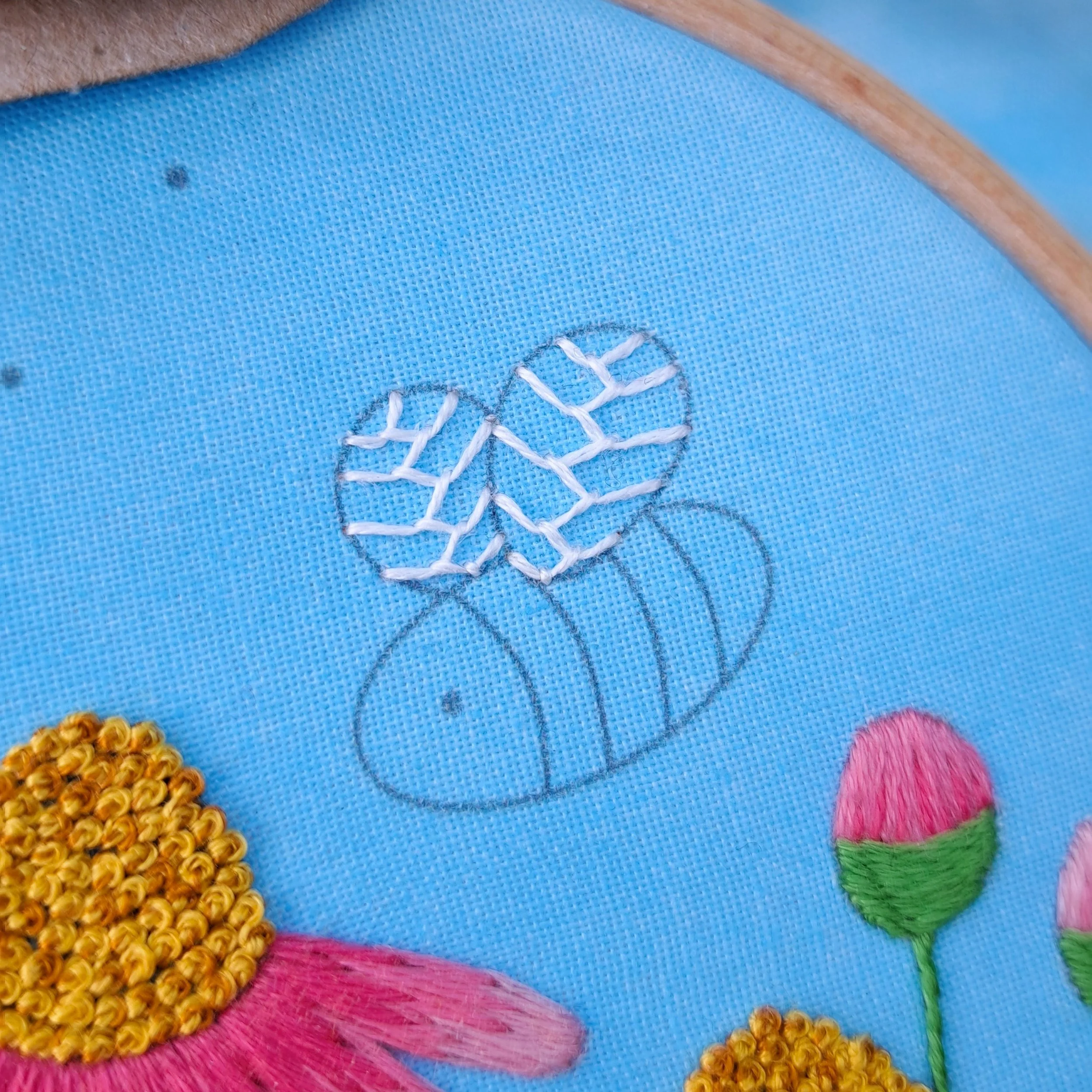
I loved the idea of stitching these wings so that the blue background could show through, giving that slightly transparent look.
There are a few different stitches you could try here, but I used Feather Stitch for mine.
Usually, I like to draw a couple of guidelines to help keep this stitch nice and even, but I was a little worried about the pen not lifting properly from the watercolour and leaving marks. So in the end - and since these are quite small areas - I just eyeballed them 😃
I stitched the edges right on the wing outlines so that I could stitch over the edges in the next step.
Stitch – Feather Stitch
Thread colour – Anchor 2 (White)
Number of strands – 2
Needle size – Small
The Big Bee - Outline
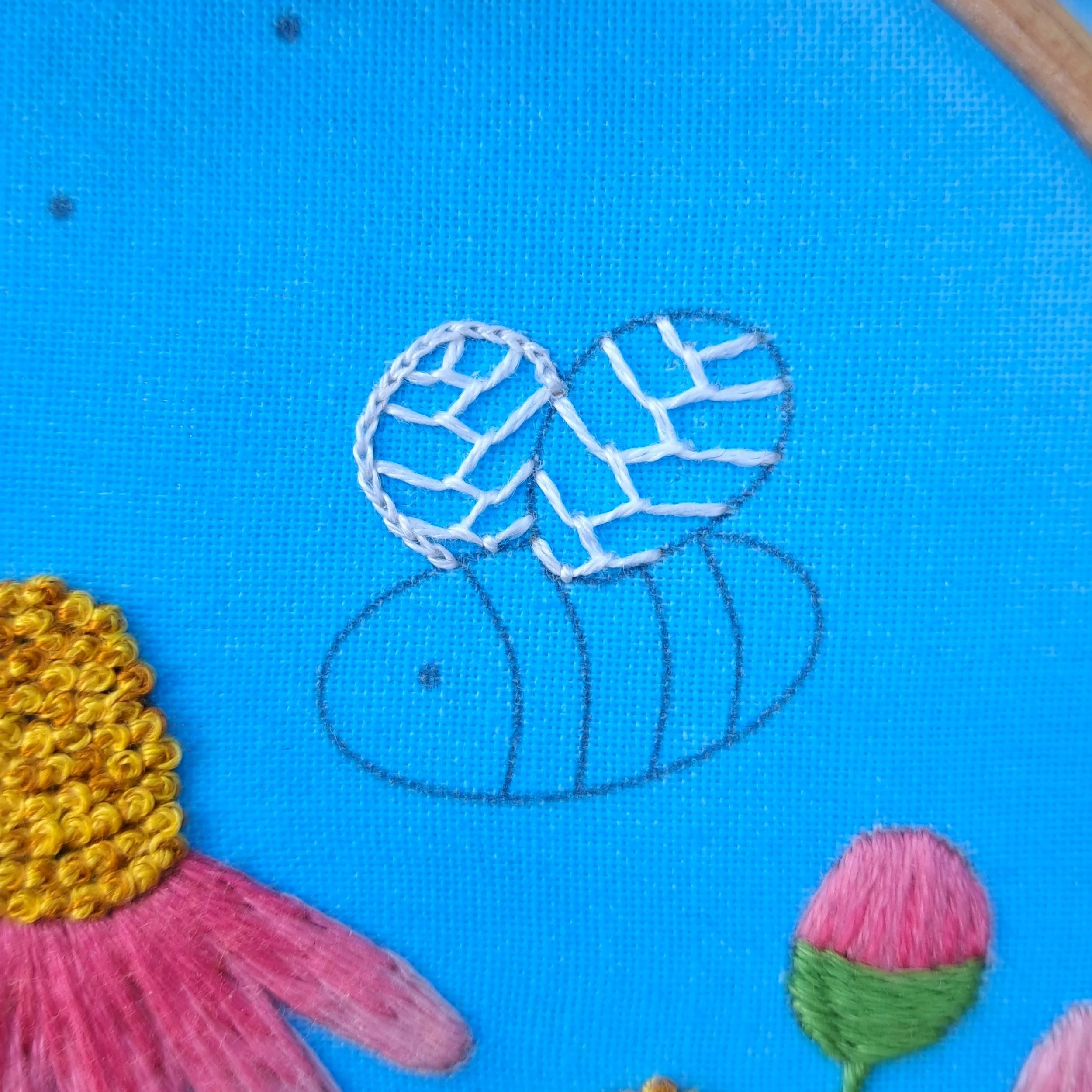
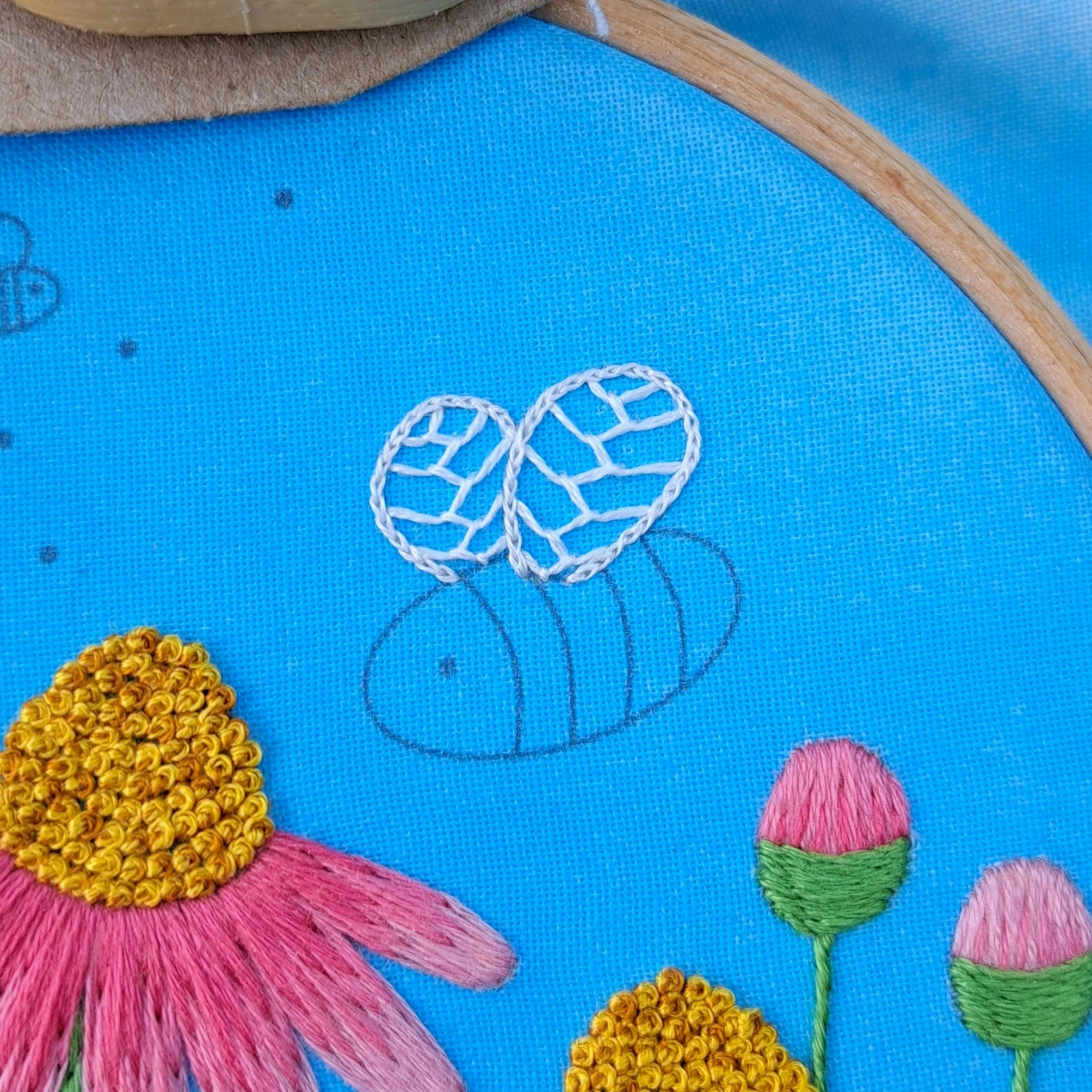
To finish the wings, I stitched a row of Split Stitch along each of the outlines.
I didn’t stitch the very bottom edge of the front wing, as that will be covered when we stitch the bee’s body.
I kept my stitch length really quite small here - remember, keeping your stitches on the smaller side will help keep the curve nice and smooth.
I stitched the outline of the back wing first, then the front wing, so that the front wing sits neatly over the top.
Stitch – Split Stitch
Thread colour – Anchor 2 (White)
Number of strands – 2
Needle size – Small
The Big Bee - Body and Eye
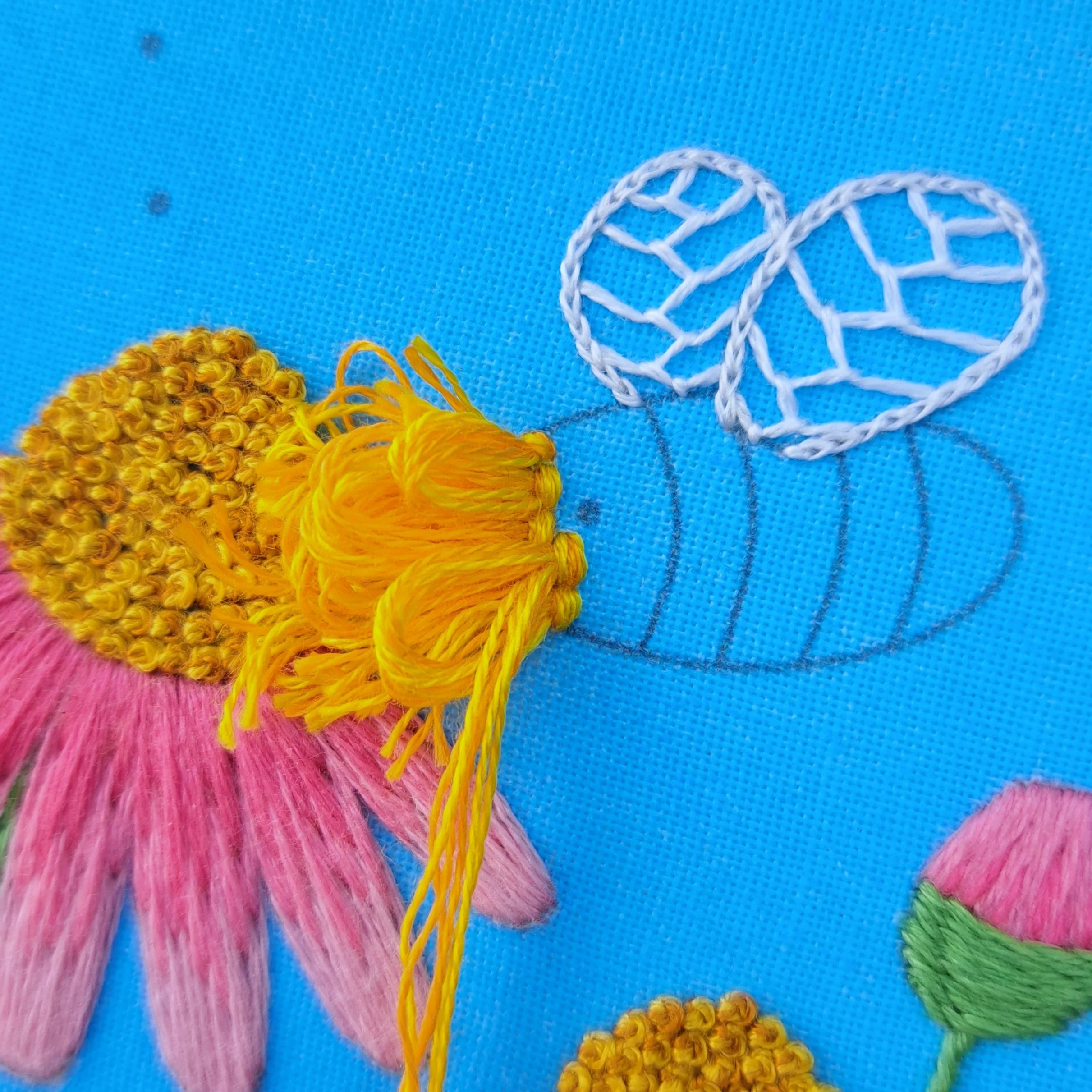
⚠️ Warning! This bit is going to look a little crazy and chaotic at first 😅 - but it does turn into a super cute fluffy bee in the end!
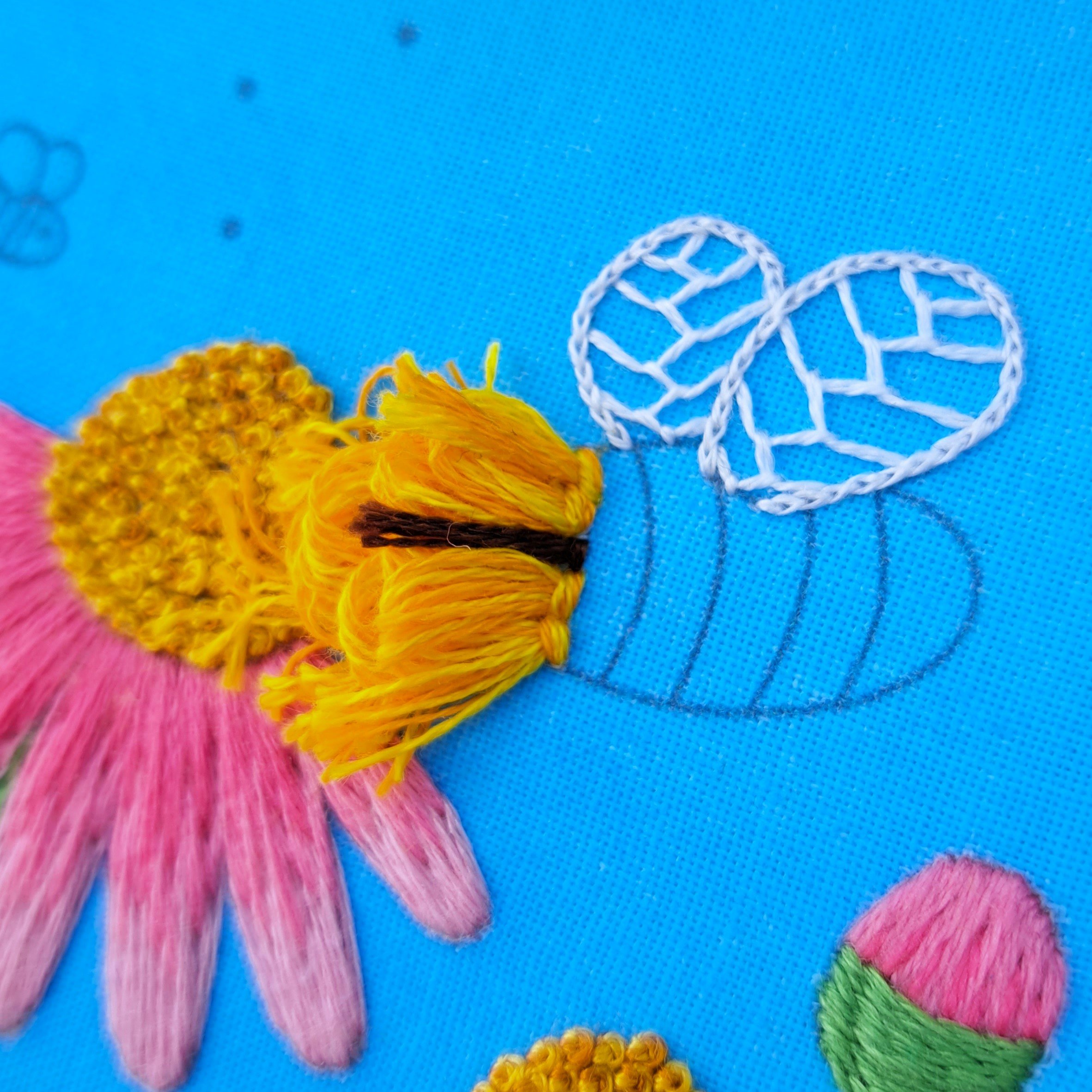
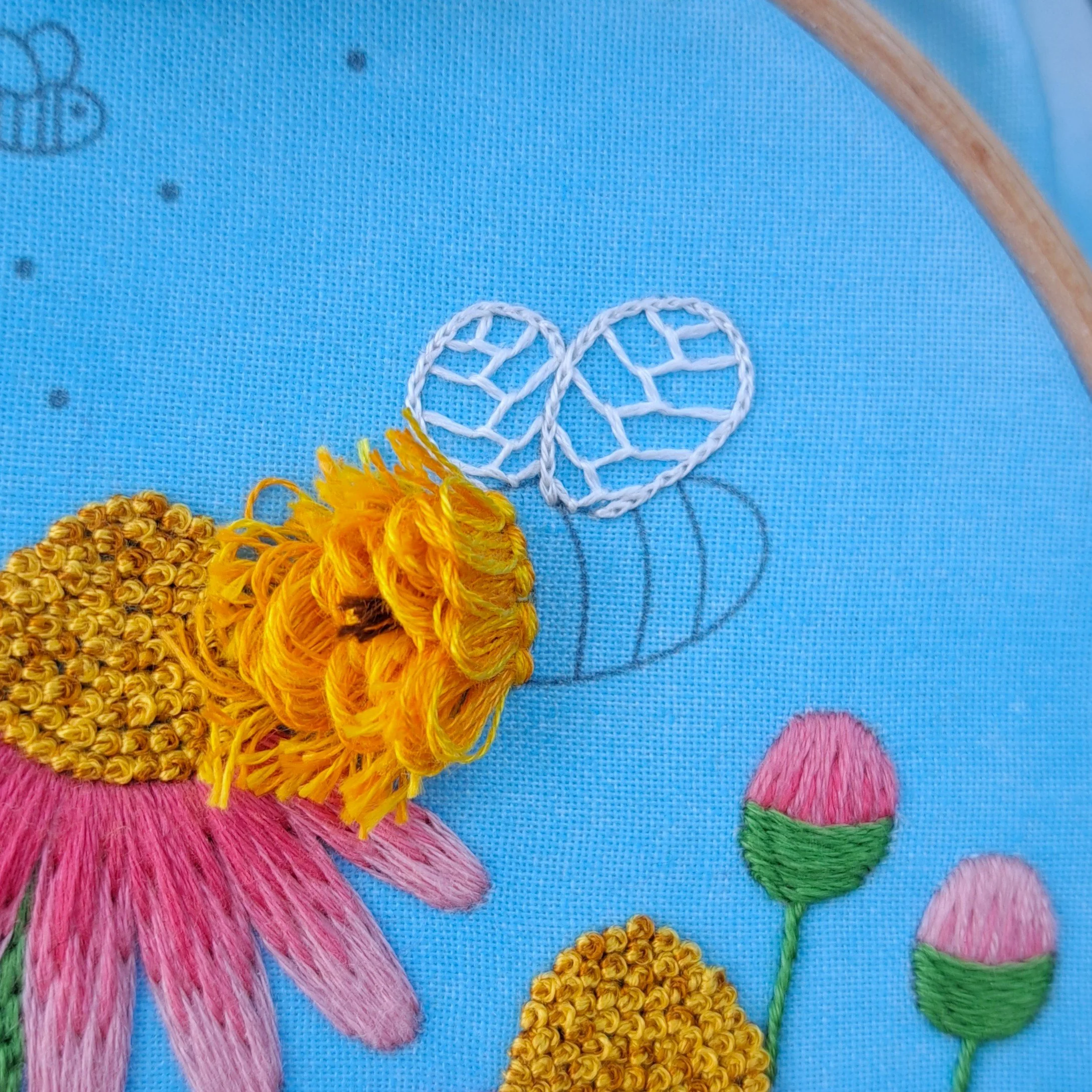
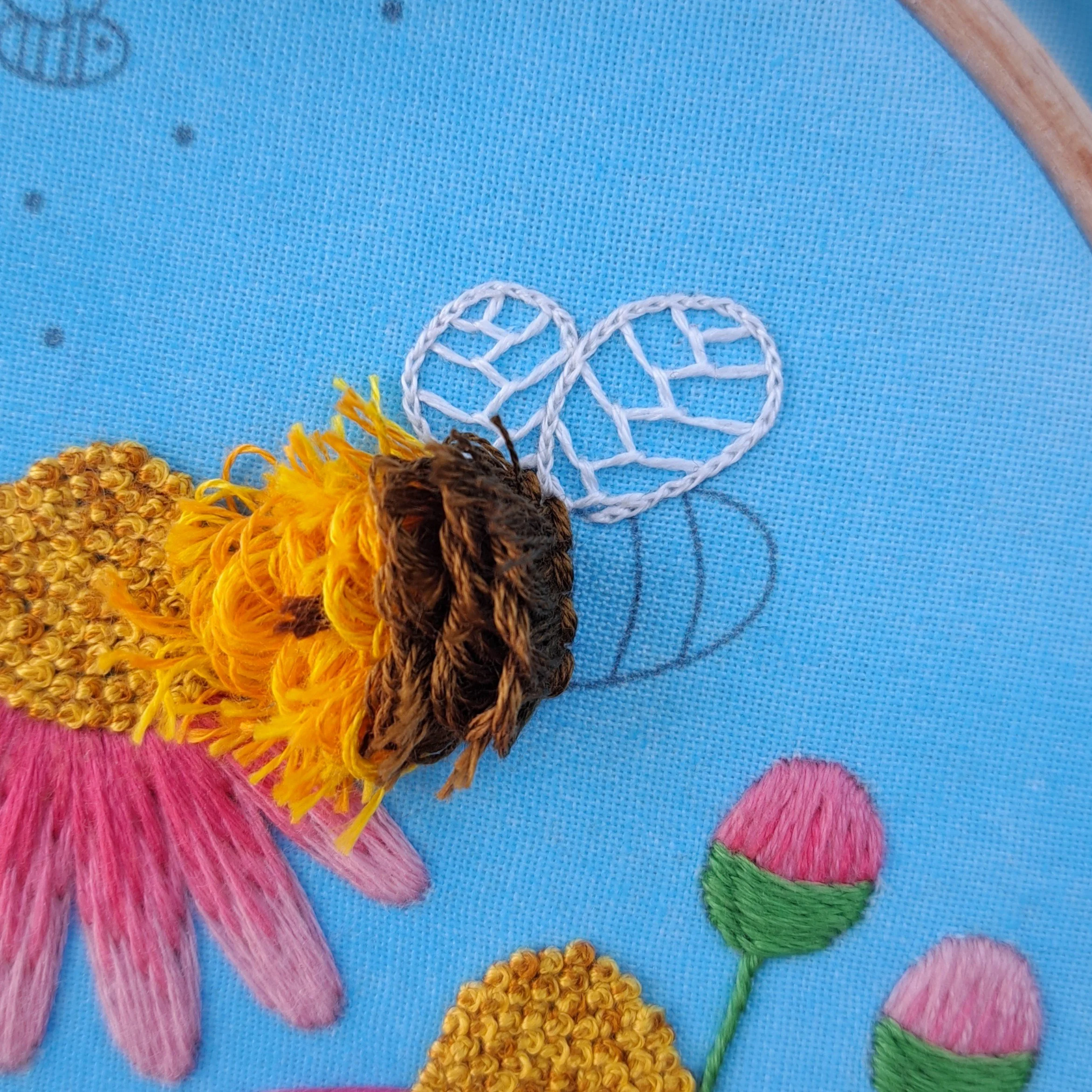
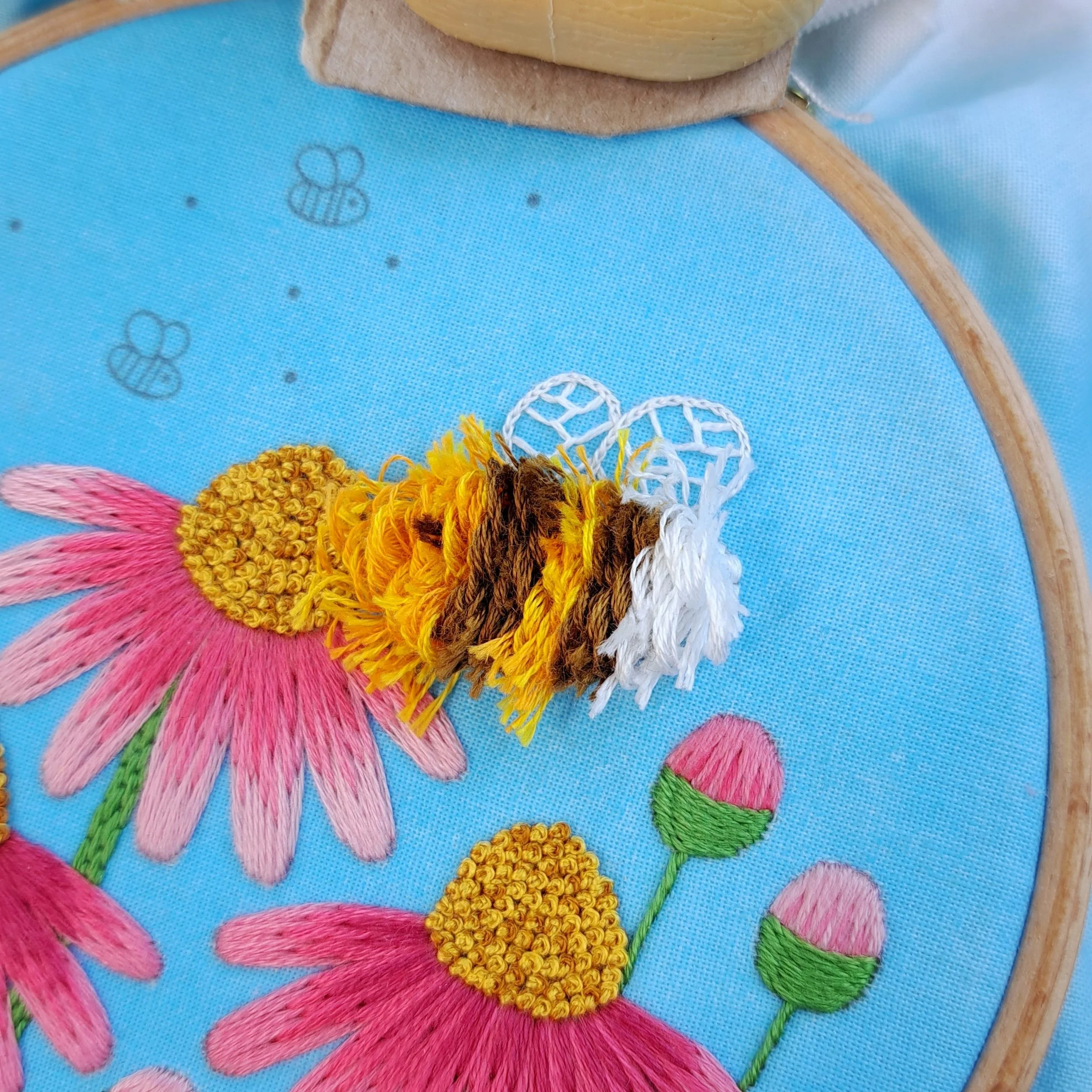
I filled the entire body with Turkey Stitch using 6 strands of thread. I started at the bee’s “nose” (do bees have noses? I’ve never actually thought about it before 🤔😄) and stitched vertical rows across the body, changing colours as I moved through each stripe.
The tighter you pack your stitches here, the thicker and fluffier your bee will be once it’s trimmed - so it’s definitely worth having a little practice on scrap fabric first to get a feel for the density you like. It’s also really helpful for testing colours, because Turkey Stitch looks quite different once it’s cut - you’re seeing the ends of the threads rather than the smooth strands.
When I reached the row with the eye, I stitched the orange row up to the eye using 6 strands as normal. Then I added one single Turkey Stitch for the eye using 2 strands of Anchor 359 (Dark Brown), before continuing the rest of the row in orange.
For the colour bands, I used:
Orange bands:
3 strands of Anchor 298 (Yellow) and 3 strands of Anchor 314 (Orange) combined and stitched together to make a subtle, mottled effectBrown bands:
6 strands of DMC 869 (Light Golden Brown)White band:
6 strands of Anchor 2 (White)
Stitch – Turkey Stitch
Thread colours – Anchor 298 (Yellow), Anchor 314 (Orange), DMC 869 (Light Golden Brown), and Anchor 2 (White)
Number of strands – 6 for the body, 2 for the eye
Needle size – Large and Small
✂️ Trimming the Bee
Now for the really fun (and slightly scary) part… the trimming! 😃
I always start by cutting all the loops - and yes… it looks even more chaotic at this stage!
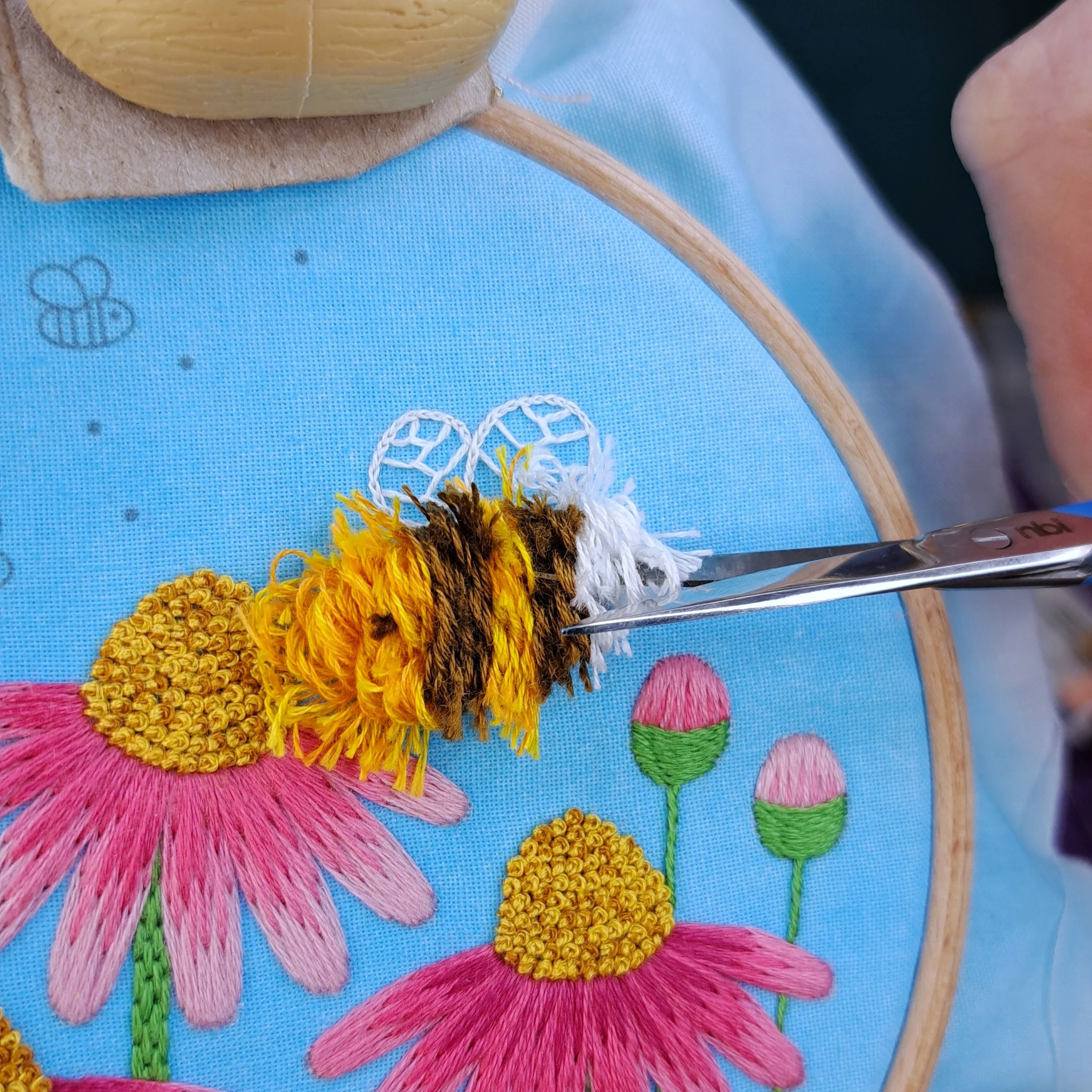
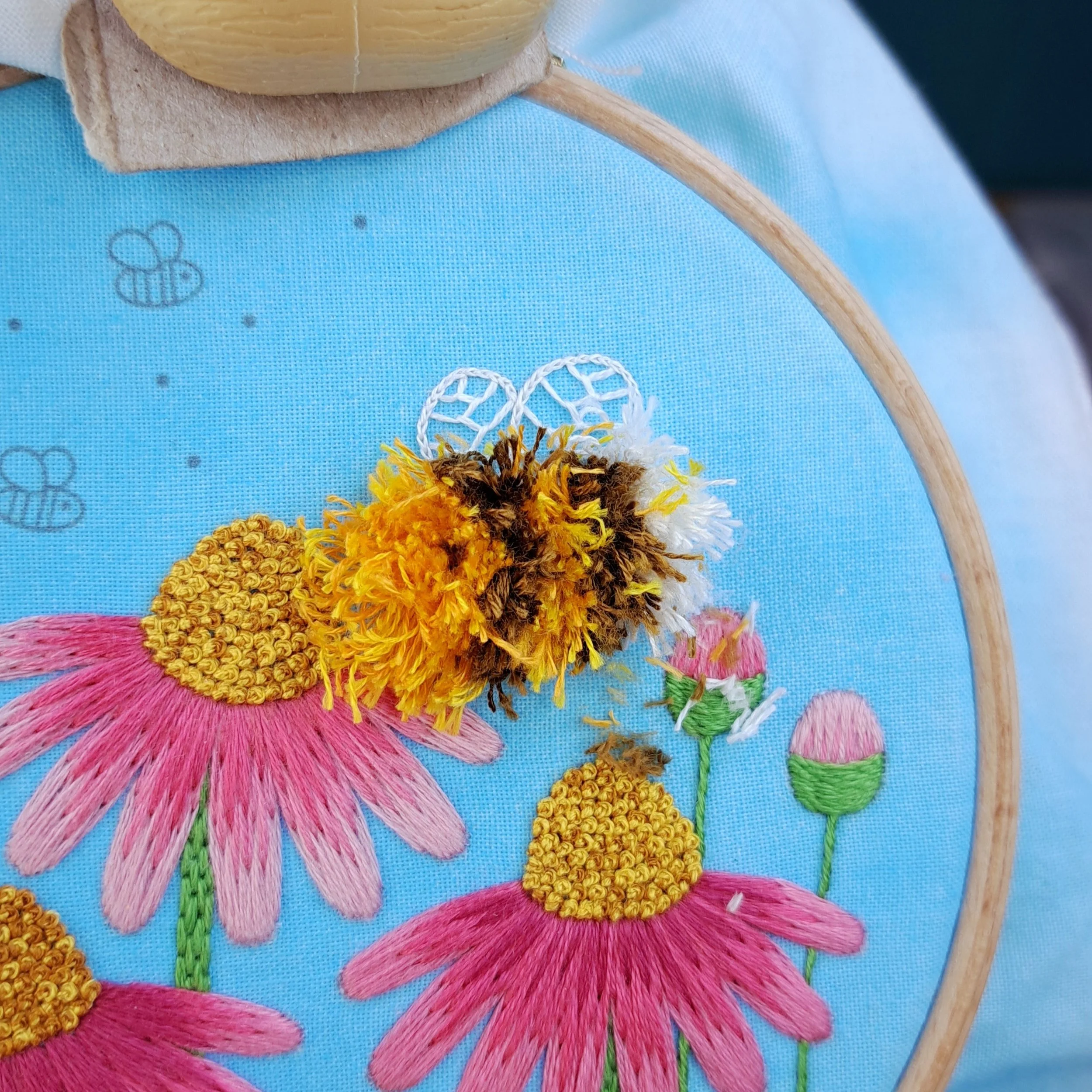
Then I gradually trim the threads down to shape the bee. My biggest tip here is to go slowly and trim a little at a time. Once it’s cut, you can’t stick it back on (well… not without a lot of unpicking and restitching😅).
Because I stitched mine quite densely, I did switch to my larger fabric scissors for some of the trimming. I shaped the body so it’s nice and rounded and fluffy.
✨ A Little Tip:
I use a bit of masking tape to pick up all those tiny thread clippings from the hoop - it works so well! Just be careful not to stick it onto your stitching.
Sometimes I also find a quick blast with a hairdryer also helps shift any stubborn fluff.
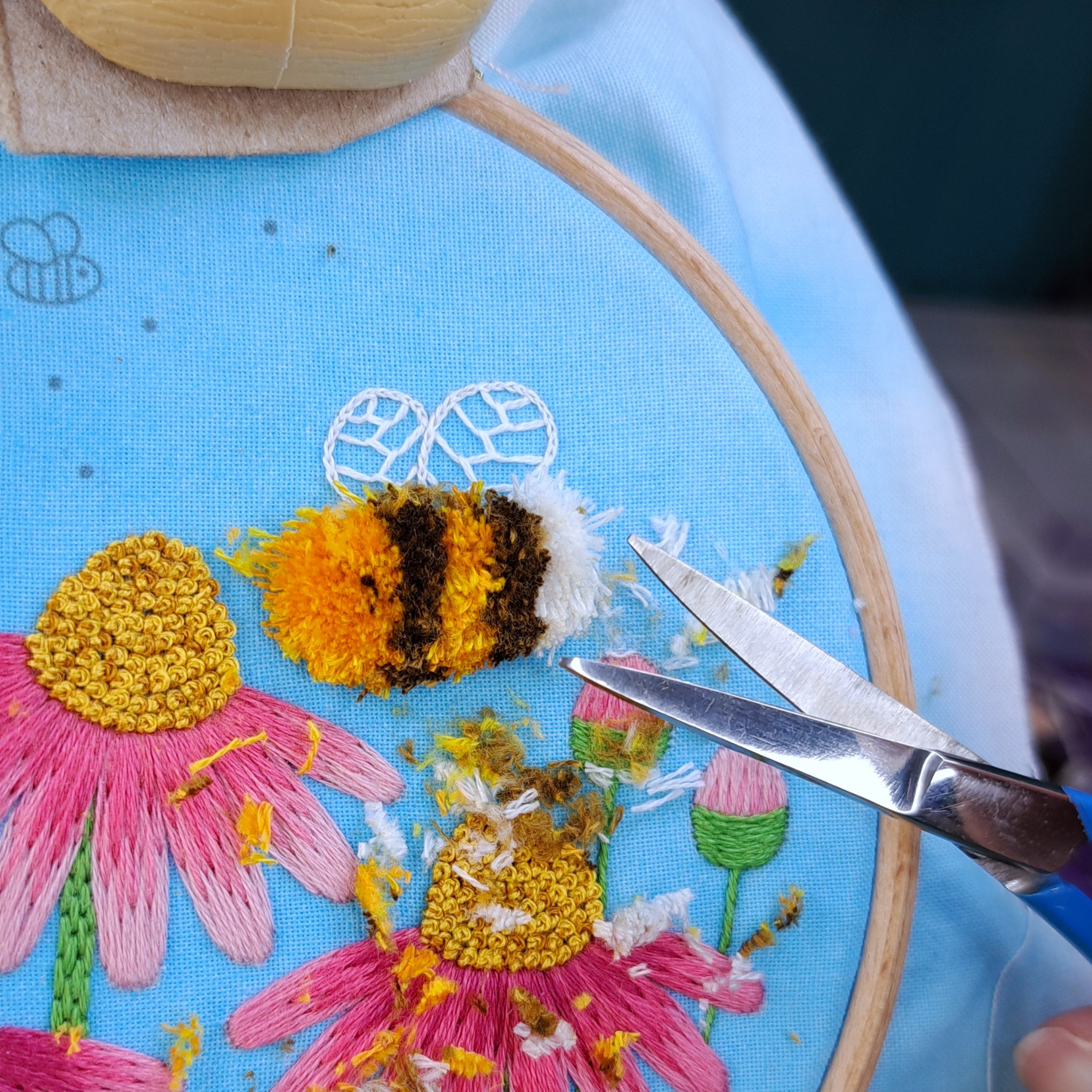
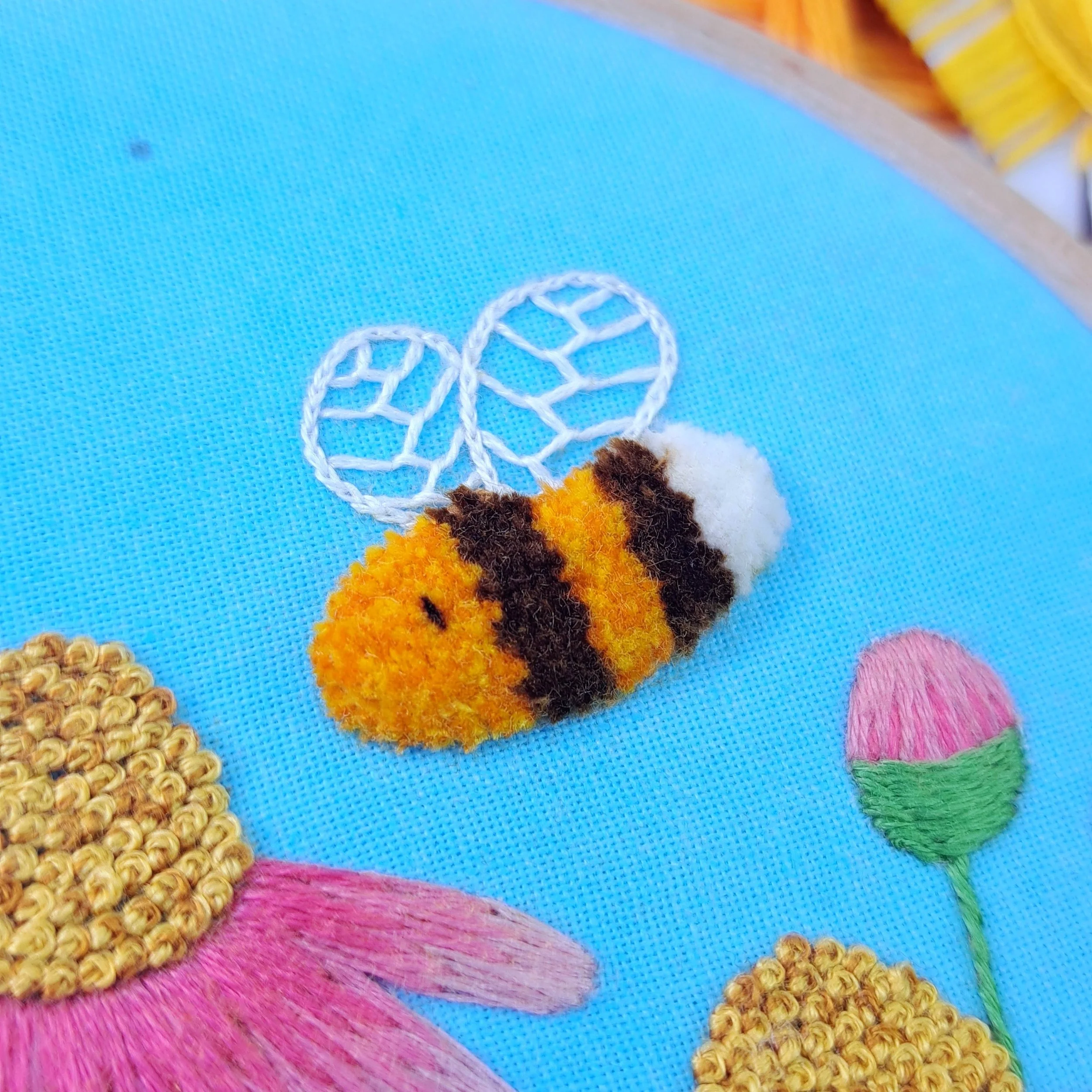
And there we go - a cute fluffy bee was hiding in there all along! 🐝
Now on to the smaller bees…
I stitched mine one bee at a time, but you could absolutely work each step across all of them if you prefer.
The Smaller Bees - Wings
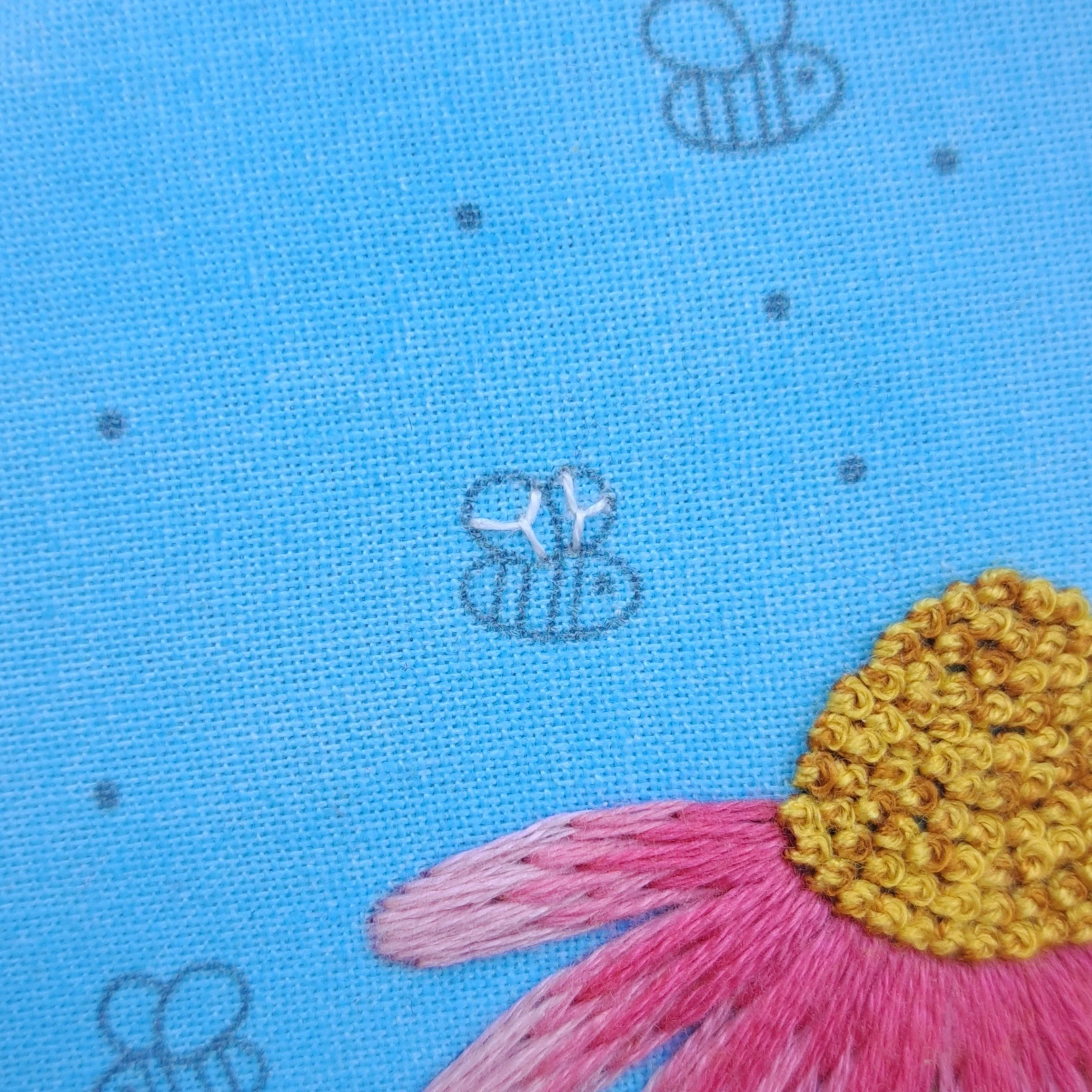
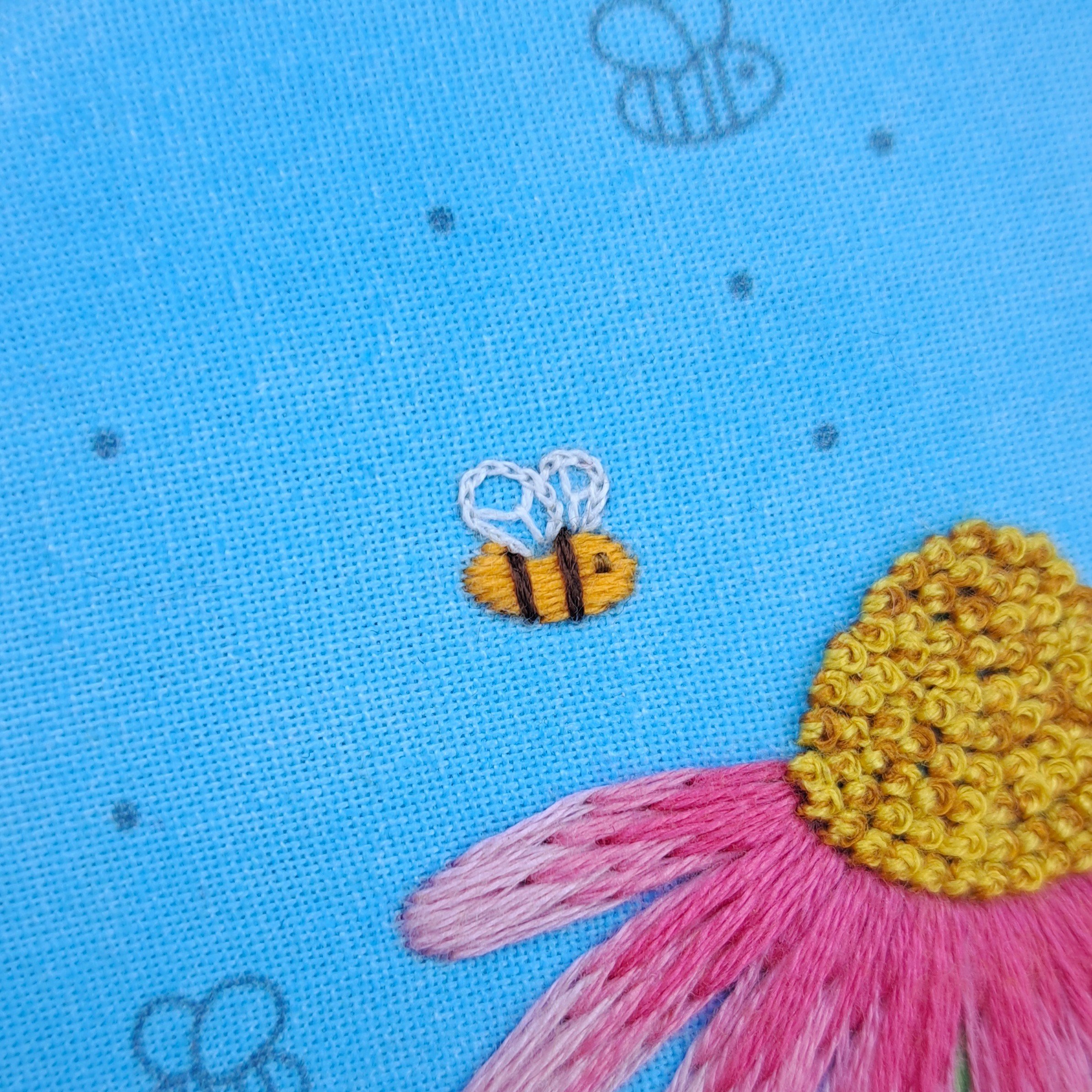
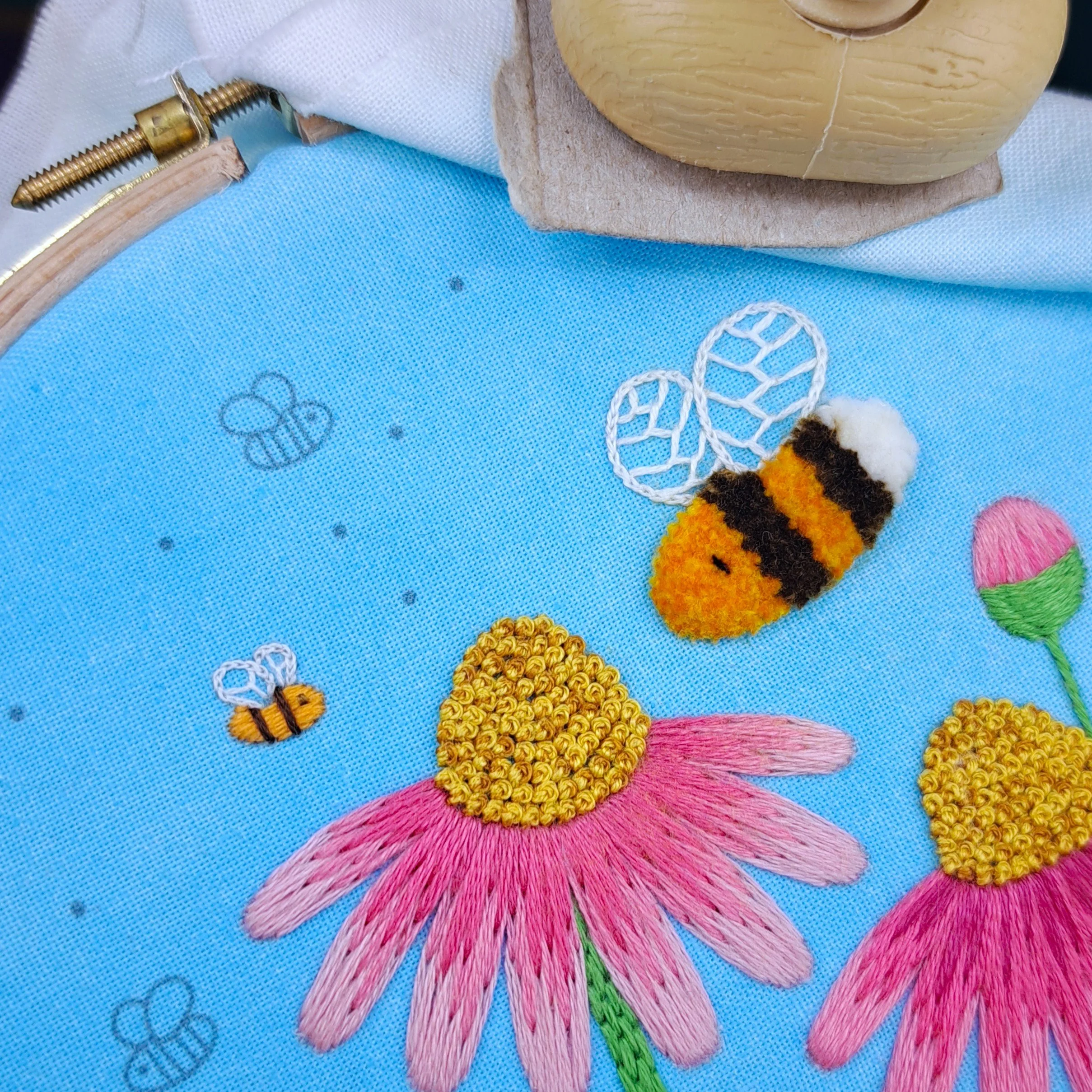
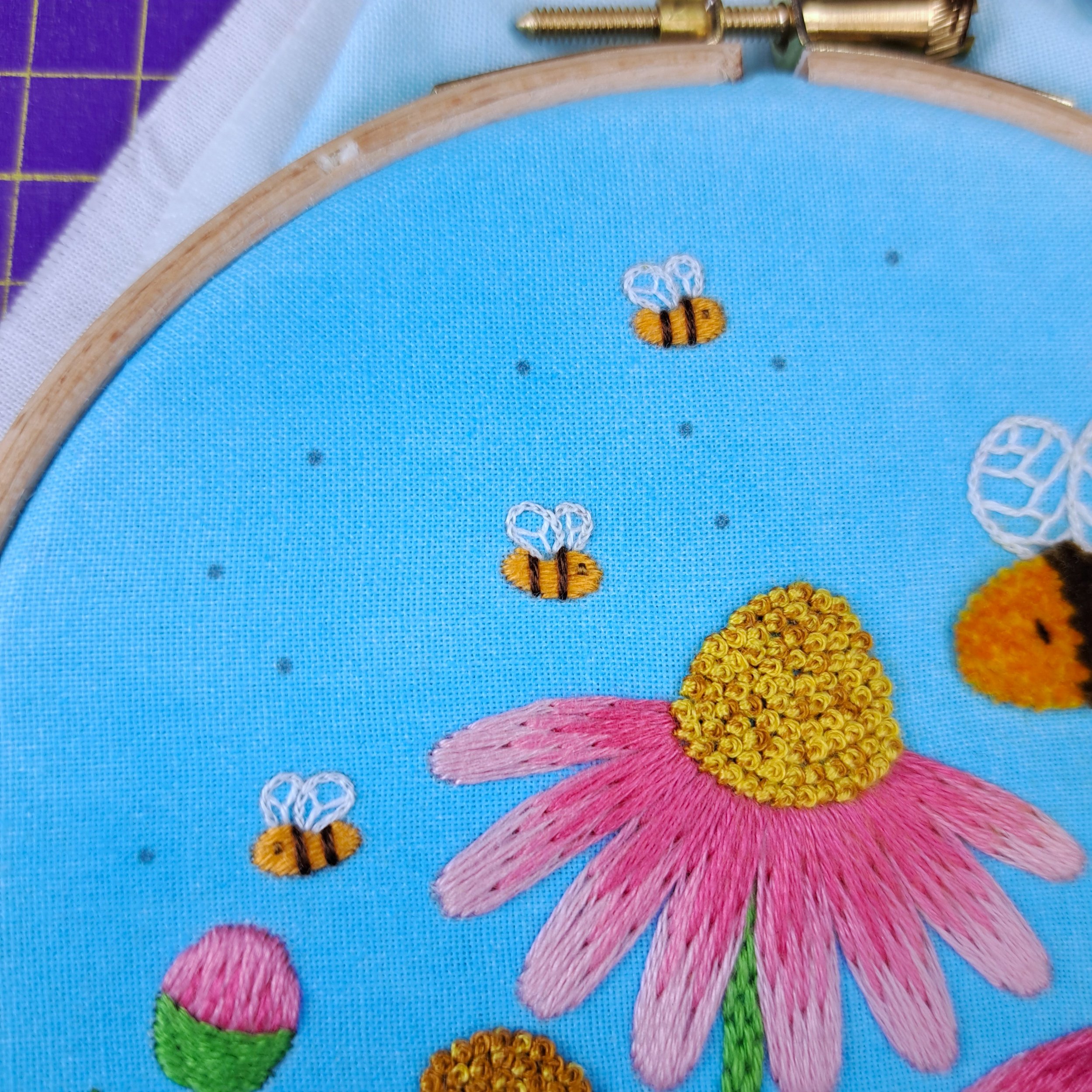
For these wings, I stitched just a single Fly Stitch in each one to give a similar effect to the bigger bee’s wings.
Stitch – Fly Stitch
Thread colour – Anchor 2 (White)
Number of strands – 1
Needle size – Small
The Smaller Bees - Wing Outlines
Now… these stitches are super teeny! Honestly, I think I had my hoop about an inch from my face while stitching these 😅
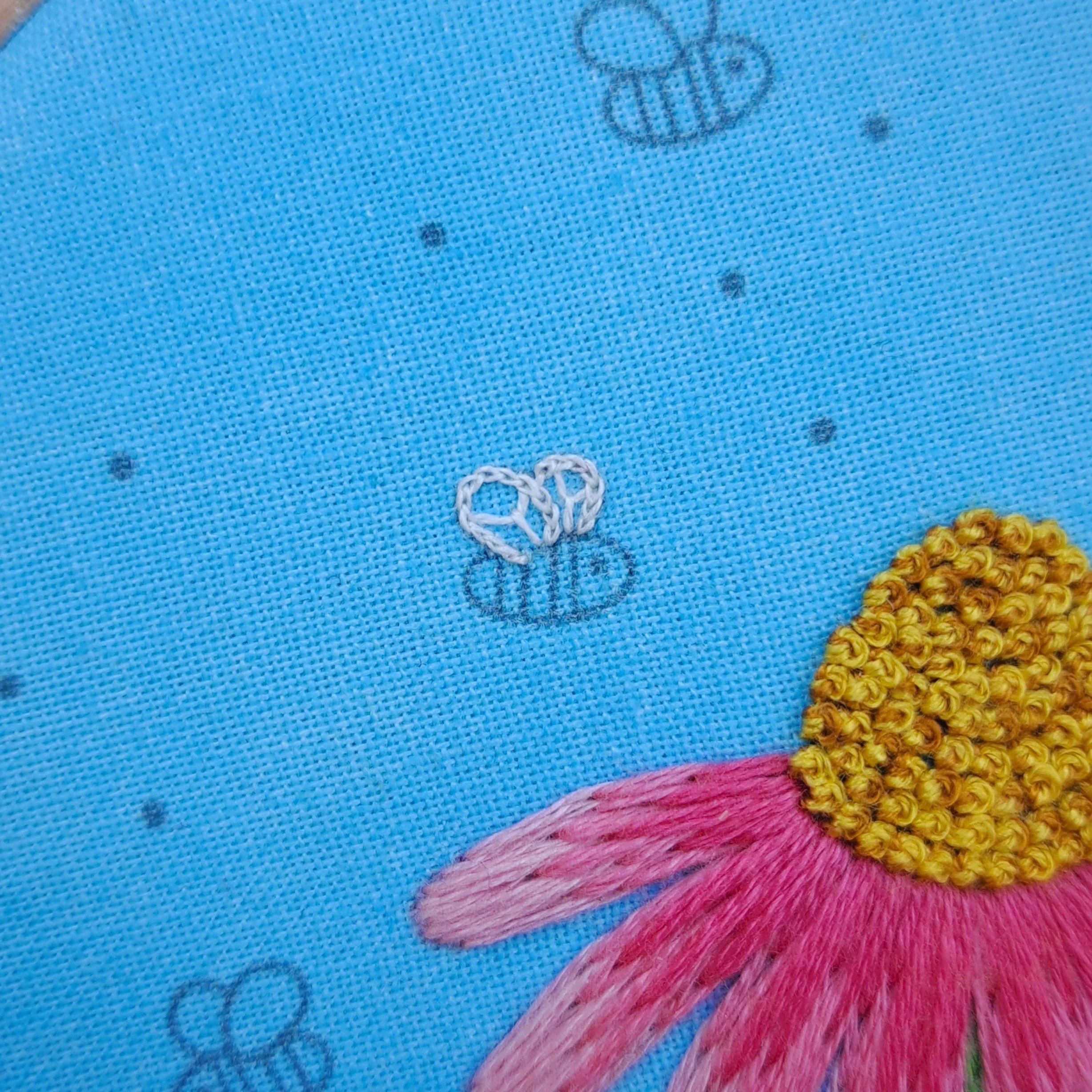
I added a row of Split Stitch along each wing outline, just like I did for the big bee - but this time using only one strand.
(And yes… you can split one strand! If you look closely, a single strand is actually made up of even finer twisted threads 😃)
I really love how these delicate little wings turned out, but they definitely require a bit of patience.
If you’d prefer, you could absolutely swap this out for a different stitch -Backstitch or Stem Stitch would both work well. Or, you could fill the wings completely with Satin Stitch instead and skip the outline altogether.
Stitch – Split Stitch
Thread colour – Anchor 2 (White)
Number of strands – 1
Needle size – Small
The Smaller Bees - Body
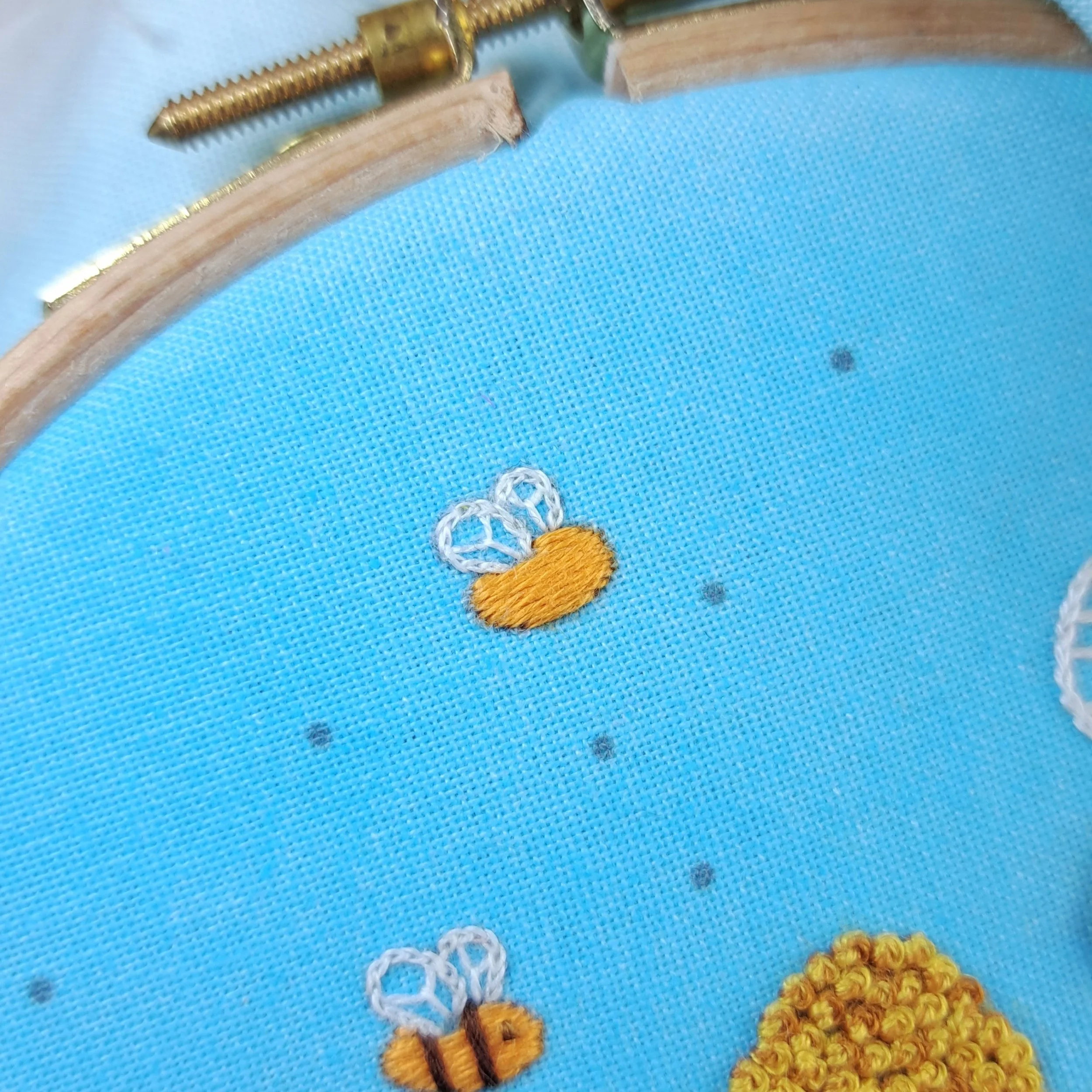
I filled each of the bodies with horizontal Satin Stitch, stitching straight across the whole shape and going right over the stripes (we’ll stitch these over the top in the next step).
Stitch – Satin Stitch
Thread colour – Anchor 314 (Orange)
Number of strands – 2
Needle size – Small
They do look like flying baked beans at this point – but stay with me 😄
The Smaller Bees - Stripes
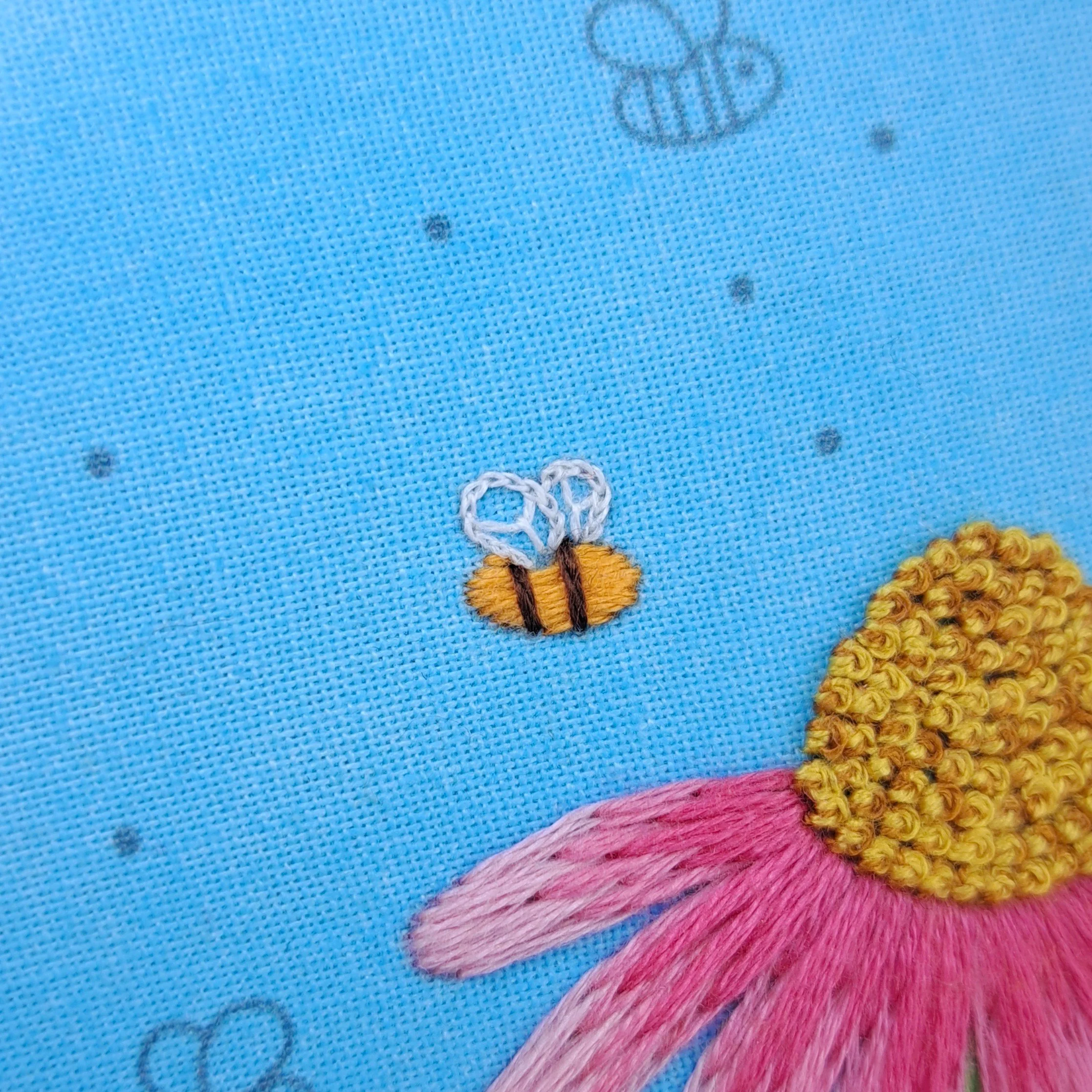
Next, I added the stripes using Straight Stitches - just one stitch per stripe.
You won’t be able to see where the stripes are “supposed” to go, so I just spaced them out roughly evenly by eye.
Stitch – Straight Stitch
Thread colour – Anchor 359 (Dark Brown)
Number of strands – 2
Needle size – Small
The Smaller Bees - Eyes
To finish these cute little bees, I added one tiny Couch Stitch for each eye.
Just like the stripes, you can’t see where these are ‘supposed’ to be - so pop them wherever looks right to you, and make them as small or bold as you like. It’s amazing how much character such a tiny stitch can add!
Stitch – Couch Stitch
Thread colour – DMC 869 (Light Golden Brown)
Number of strands – 1
Needle size – Small
Nearly there! Just the tiny distant bees to go 😊
The Tiny Distant Bees
And finally, I stitched these tiny distant bees using French Knots with 1 wrap.
I did start and stop each knot individually - you definitely don’t have to do this - but I was a bit undecided on colours for this step 🙈 I’m actually really glad I did, because it meant I could snip out a few knots and change them without affecting the others. So if you’re feeling unsure too, you might want to do the same.
Originally, I stitched a mix of orange and white knots - but the white ones seemed to take away from the wings a little. So I snipped them out and went with all orange in the end, and I love how they look now.
Stitch – French knot (1 wrap)
Thread colour – Anchor 314 (Orange)
Number of strands – 3
Needle size – Medium
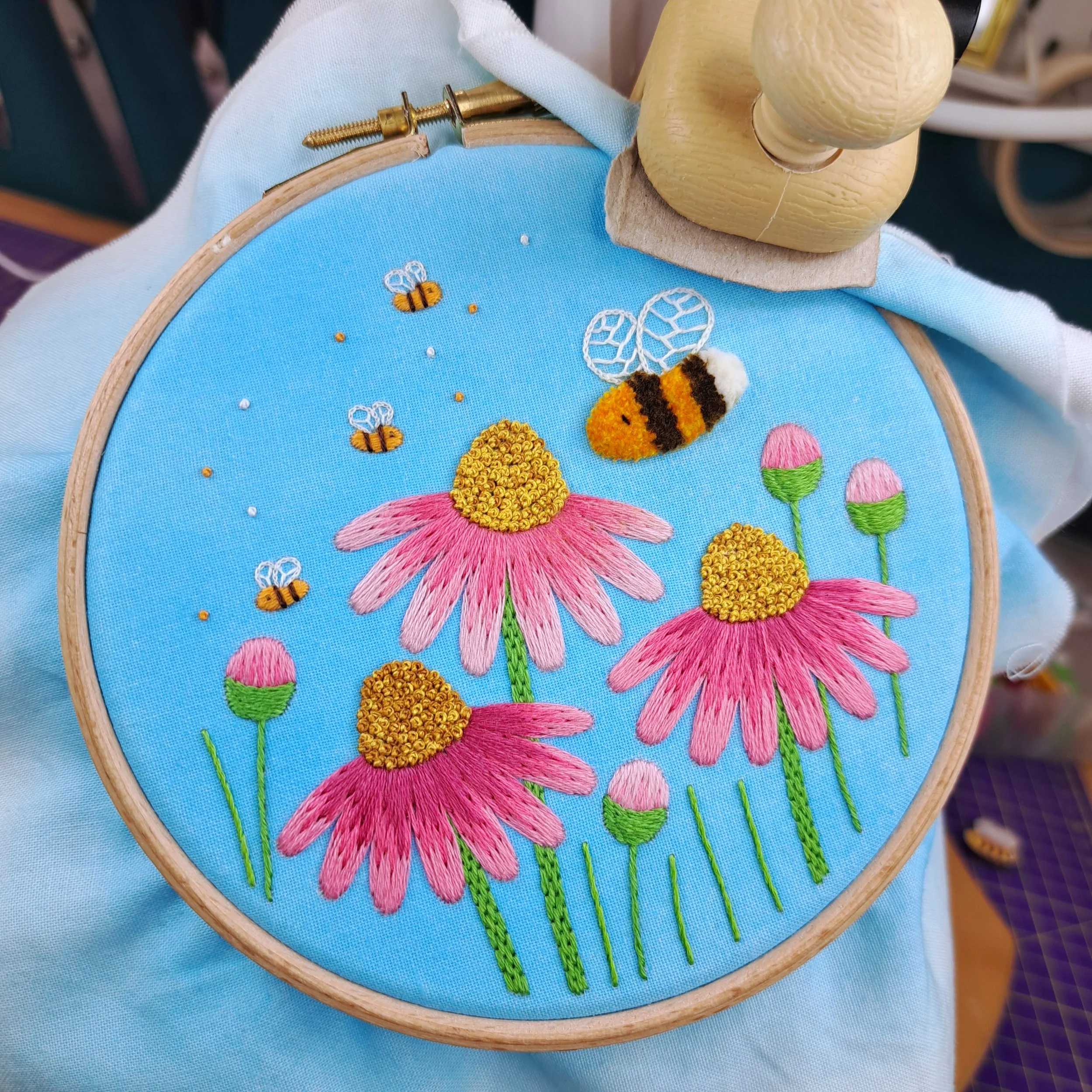
This is how it looked with some of the distant bees stitched with white.
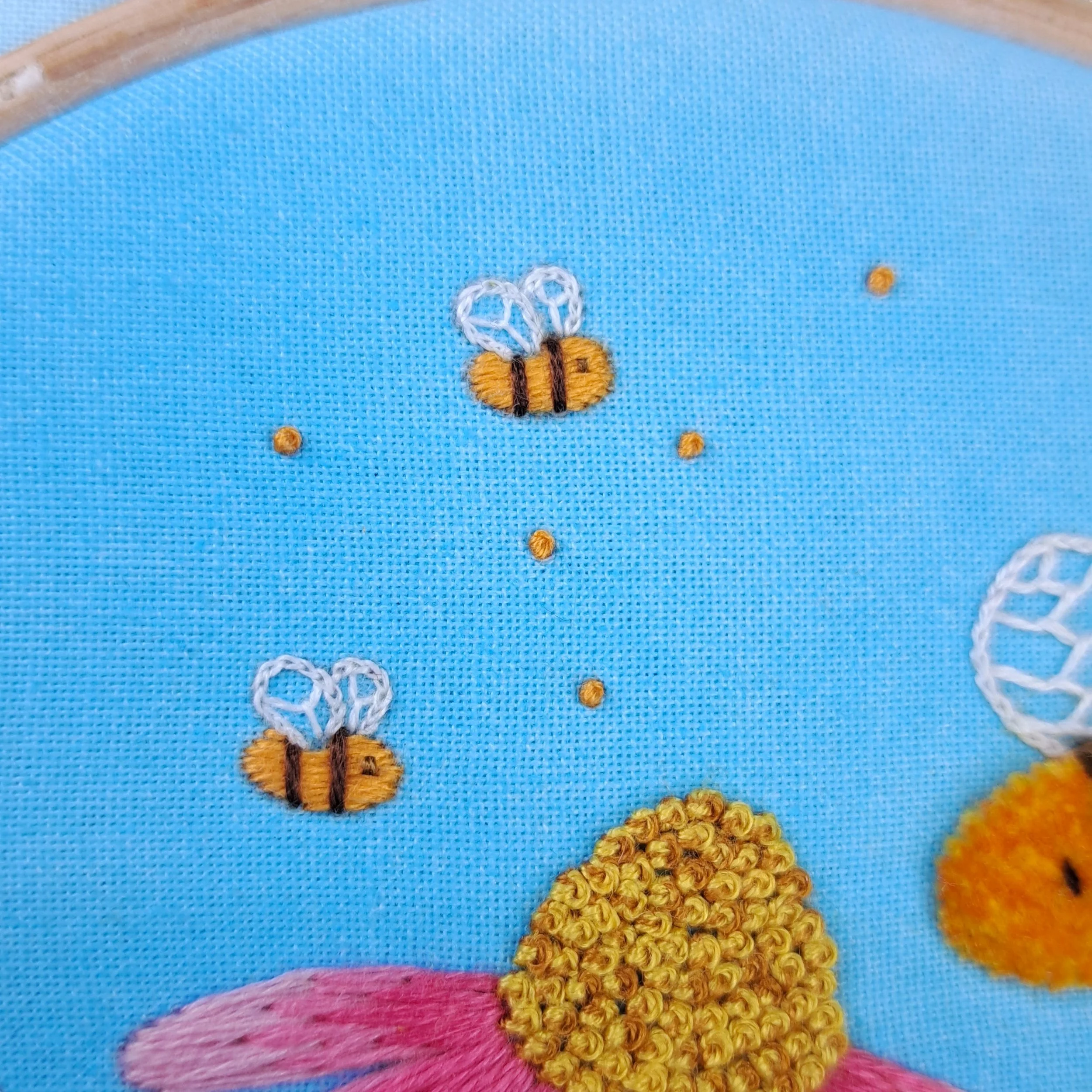
I went with all orange distant bees in the end.
And that’s it!
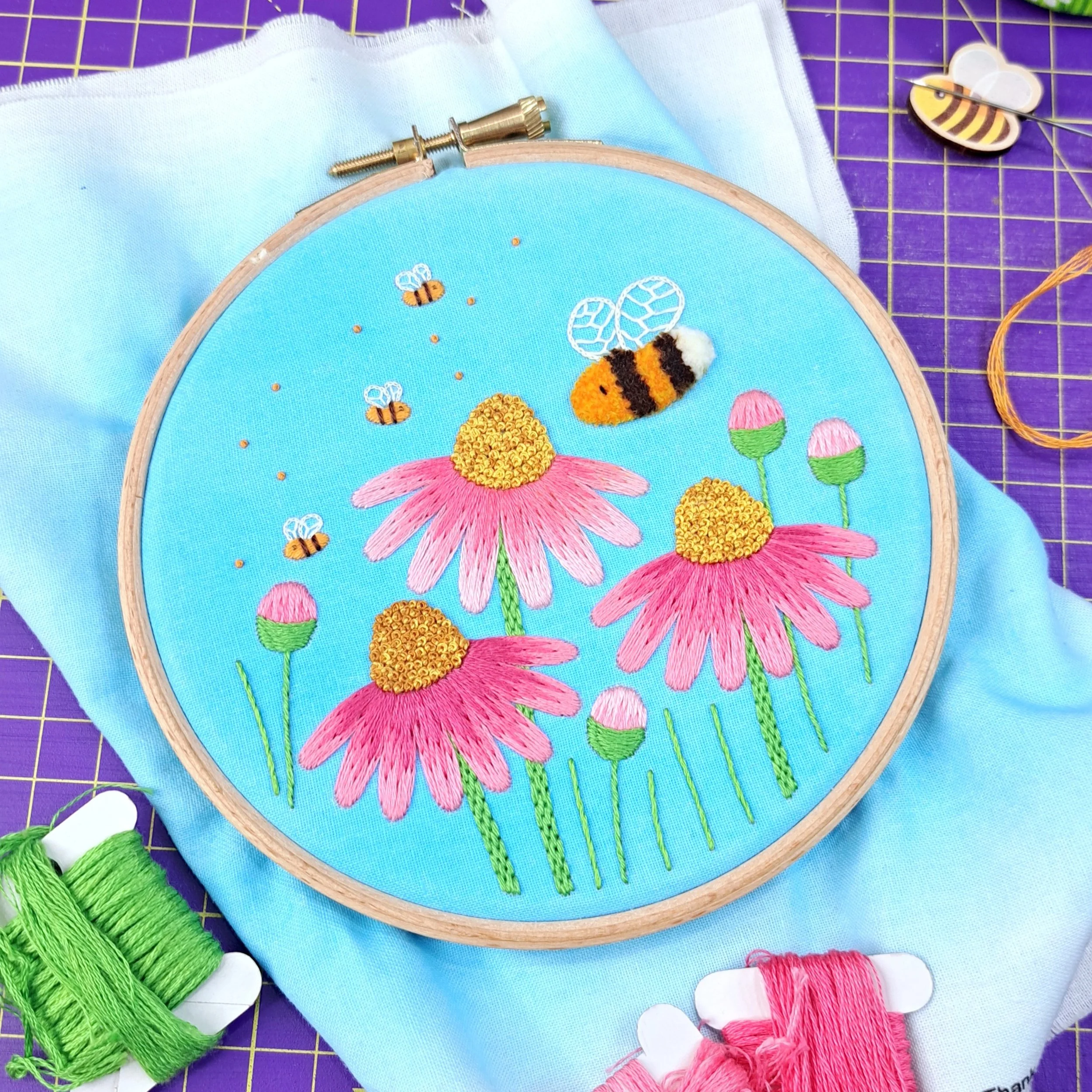
This Bee and Echinacea panel is fully stitched🎉 I absolutely love how this one turned out – especially that fun, fuzzy bee! 😍 And those smaller bees are super cute!
5. Finishing and Displaying your Embroidery
You can frame your finished embroidery right in the hoop you used for stitching - one of my absolute favourite ways to display projects.
To do this, trim away the excess fabric, leaving a few centimetres all the way around. Then, stitch a running stitch about 1 cm from the fabric edge using 6 strands of thread, leaving unknotted tails at both the start and the end. Gently pull these tails to gather the fabric in, then tie them together in a knot to hold everything neatly in place.
I’ll show you how to do this in this video (it’s a Christmas one, sorry about that! 🙈 but the process is exactly the same):
The best part about this method is that it’s not permanent - so if you ever decide to add more stitching later, you can easily unpick the running stitches and keep going until you’re happy.
Then, step back and admire your beautiful stitching!
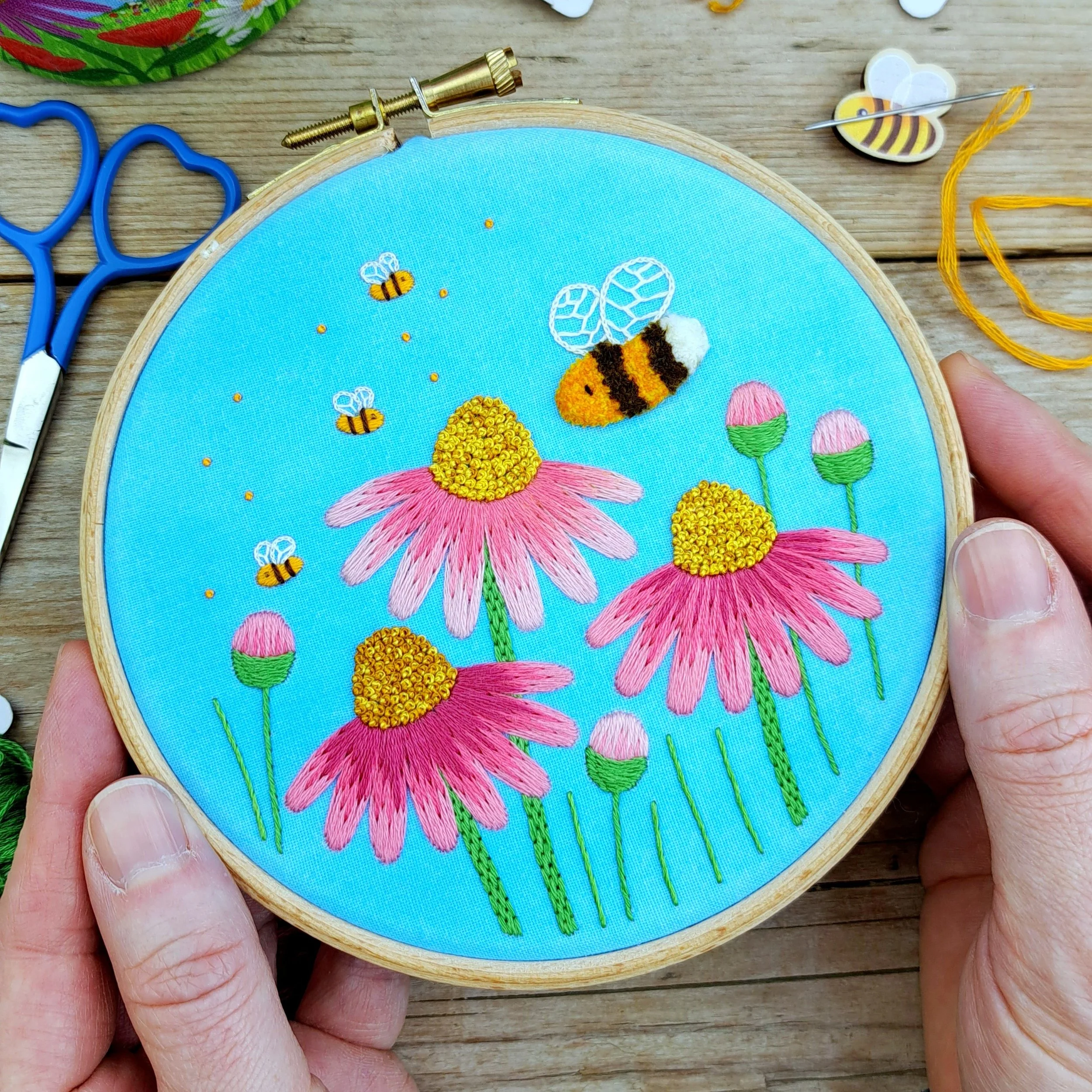
I hope you loved this project as much as I did!
I’ll be stitching my way through all my new embroidery designs (there are 15 of them - eek! 🥰) and I’ll be adding more step-by-step blog posts like this as I go. But of course, you can dive straight into stitching them right now!
If you need a bit of guidance, the Panel Packs come with a stitch suggestion sheet, and many of the techniques from my hand-printed panels still apply to the new designs.
You can find them all here……….
And don’t forget to tag me on social media when you show off your beautiful work - I’d love to see it!

If you enjoyed this blog and would like to support my work, feel free to visit my Ko-fi and leave a tip - every little bit helps keep the creativity flowing! 🌸
Enjoy your stitching!
Until next time,
Liz x